

The Identity of an Instructional Leader
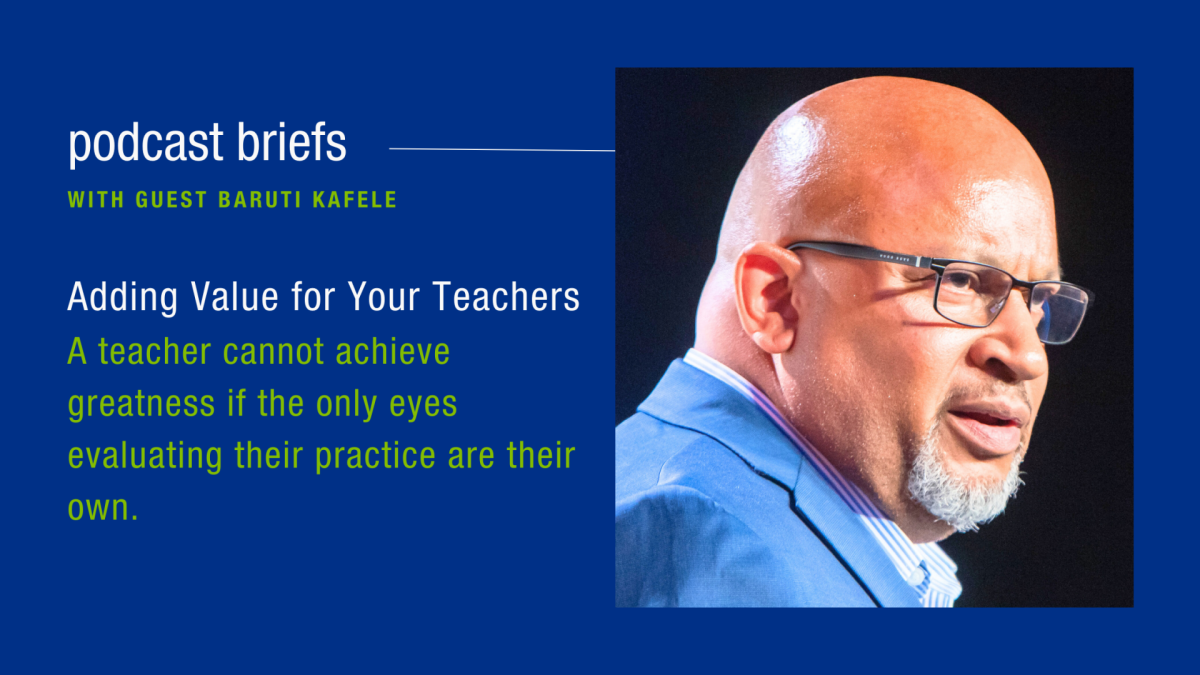
This week on our Making Schools Work Podcast, we talk to Principal Baruti Kafele about what it means to be an instructional leader and how that leader can best add value to their teachers.
In the first half of our conversation with Kafele, we move past the logistical hurdles of school management to address a foundational, and often uncomfortable, question for every administrator: What is your instructional value to the teachers you supervise?
The “Locker Room” of School Culture
Kafele argues that the culture of a building is an immutable reflection of its leadership. He uses a sports analogy to highlight a common disconnect in modern education:
- In professional athletics, a coach would never remain in the locker room during the game or skip practice to complete administrative paperwork.
- In the school environment, the teacher is the athlete, the administrators are the coaches and every single day students are in the building is game day.
- If leadership only enters the classroom during formal evaluation seasons, the opportunity for genuine coaching is lost to the compliance of the office.
The Hidden Danger of Satisfactory
When leaders lack consistent, formative data on a teacher’s daily performance, they often default to satisfactory ratings simply because they have no evidence to the contrary.
Kafele warns that this default setting does a profound disservice to students — particularly those who, like “Young Principal Kafele,” sit in classrooms with immense untapped potential while failing nearly every subject. True leadership value is realized only when a principal’s presence and feedback correlate directly to a teacher’s pedagogical growth.
The Process of Giving Feedback
Kafele points out that as he travels to various speaking engagements, he meets with a lot of young school leaders who let him know they are doing the work. They are heading into their teachers’ classrooms day after day.
“Great,” he tells them. “And what are you doing for pre-visit and post-visit conversations?”
Kafele makes it clear that it isn’t just about making an appearance in the classroom. To really show your teachers value, you need to do the prep and follow up work to make that appearance valuable.
The Three-Pronged Observation Process
Kafele outlines a methodical, transparent approach to this three-pronged process, which is designed to prioritize development over documentation:
- The Pre-Observation Conversation: This is a narrow, intentional dialogue focused on specific skill sets where the teacher and leader mutually agree there is room to reach the next level.
- The Targeted Observation: During the visit, the leader maintains a laser-sharp focus on the pre-discussed areas, intentionally ignoring the “noise” of the rest of the room to provide high-fidelity feedback.
- The Post-Observation Conversation: A collaborative debrief that must happen as soon as possible to maintain momentum, provide immediate reinforcement, and allay teacher anxiety.
The “Walk” and the Power of External Eyes
One of the most memorable moments of the episode is Kafele’s story about his “walk.” For years, colleagues and students remarked on his intimidating, “street-style” gait — a trait he was completely unaware of until he saw himself on film years later.
- The Leadership Lesson: We are often blind to our own habits and instructional “walks.”
- The Application: A teacher cannot achieve greatness if the only eyes evaluating their practice are their own; they need a leader who can see what they cannot.
Hearing More From Principal Kafele

You can learn more by listening to our full episode with Principal Kafele.
To hear more about what Kafele recommends you do in all three-stages of these walkthroughs, come back next week to listen to our full episode and read another recap with us.
You can also hear him speak at the Making Schools Work Conference in Nashville this July. He will be speaking on Wednesday afternoon at 1 p.m.