

Transforming Learning, Ethically
Personalize Student Learning

IT Specialist Jeff Kilner hosted a professional development session for the teachers at his school. PD can be hit or miss for many teachers, so Kilner knew he needed to keep his session focused on the needs of his audience.
He wasn’t there to give them more work or add to their already filled schedules. He was there to save them time.
Kilner knows that teachers may not always be happy to learn a new IT skill. However, he encourages them to try AI anyway.
Not because it is another thing they need to be able to do, but because, with AI’s help, they can do things like create differentiated learning for their students faster, something he knows is a priority for many of them.
The Educator
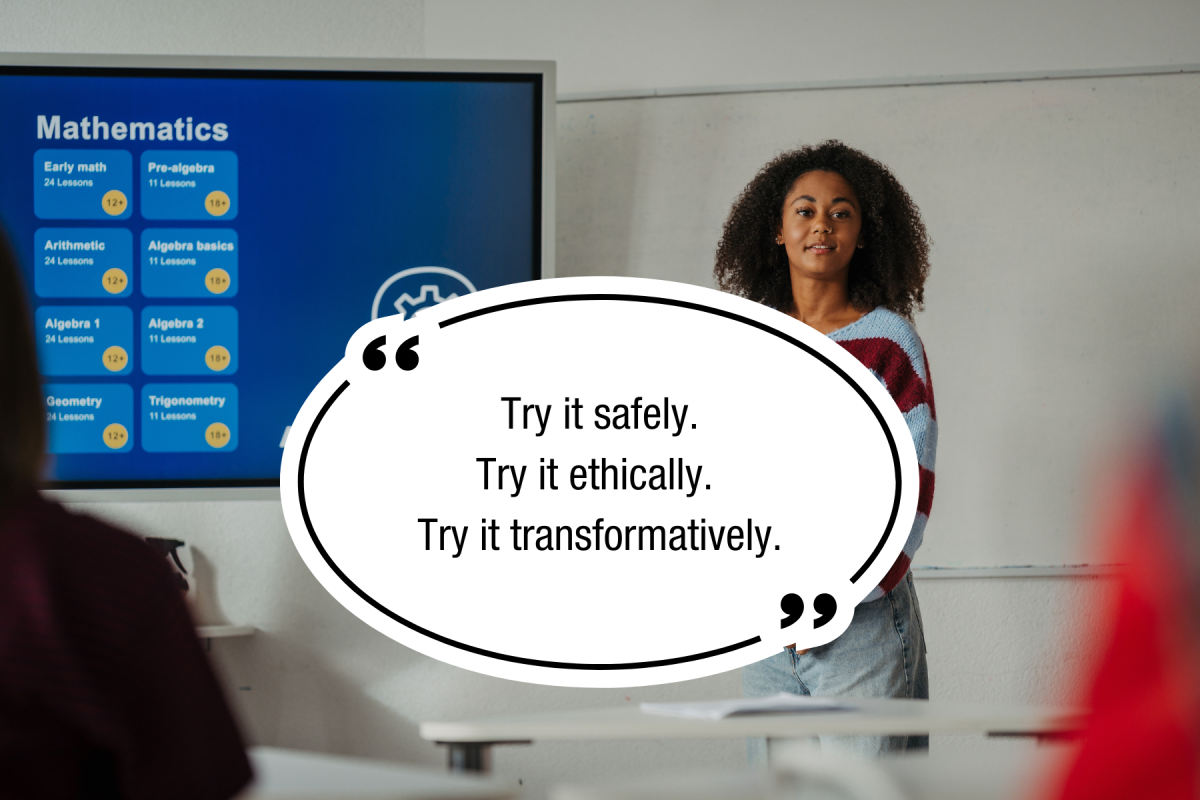
As an instructional technology specialist in Selbyville, Delaware, Jeff Kilner has encouraged Indian River School District educators interested in artificial intelligence to simply “Try It,” with the three caveats:
- Try it safely.
- Try it ethically.
- Try it transformatively.
Kilner’s courses show teachers how to safely and ethically bring AI into the classroom, encouraging teachers and staff to view AI as a thought partner, rather than something that replaces learning.
How Have You Used AI in Your Classroom?
During the 2023-2024 school year, Kilner facilitated multiple sessions for IRSD staff to gain a basic understanding of the computer science that drives Large Language Models. The sessions also included modules designed to revisit important data security practices and considerations about how to center academic integrity while supporting the use of LLMs.
He shared that in a recent professional development session, one of his participants was seeking ways to more effectively engage a group of students in her Algebra 1 coursework. She decided to try AI to help her with this dilemma.
She used AI as a thought partner to brainstorm ideas for engaging different groups of students, ranging from those requiring extra support to those mastering the standards to those who are “flying way ahead.”
In particular, for an advanced student, she put the following prompt into an AI chatbot:
“I need help brainstorming some real-life application activities for absolute value transformations.”
One of the responses from the chatbot was about absolute value and weather. She took that idea and planned a task where students could deepen their understanding of the standards with the prompt, “Research how absolute value data supports the accuracy of forecasting the weather. Use this information to explain how you would justify picking one weather forecasting provider over another.”
Students engaging with the AI-generated tasks had to research weather data from around the world, graph it and use the absolute value function to analyze patterns in the data. They then used questions developed by the teacher and the chatbot to explore what happens to the forecast when there is a change in the system, such as a change in temperature.
She shared that the task sparked excitement in the student who worked on it, and it led him to understand the standard at a deeper, more authentic level. With her permission, Kilner recorded and edited the conversation to share with other educators.
After discussions with officials at the Delaware Department of Education, Kilner was asked to create similar professional learning opportunities for all Delaware educators that were entirely self-paced and asynchronous.
The first of these courses – Foundations of Safe and Ethical Generative AI Use in the Classroom went live in October of 2024. As of June 2025, just over 1,000 educators have enrolled.
The second course, “Ethical Use of AI in the Classroom,” went live in January 2025 and currently has over 150 enrollments.
Both courses are also available as Open Education Resources.
What Has Been the Impact of AI on Your Teaching and Learning?
AI has impacted my role by underscoring the need to provide educators with foundational knowledge about how these tools function so that they can make informed choices around how, why and when to leverage AI in the classroom.
Kilner said AI has impacted his role significantly, but not through advances in productivity.
“AI has impacted my role by underscoring the need to provide educators with foundational knowledge about how these tools function so that they can make informed choices around how, why and when to leverage AI in the classroom,” he said.
What Tips or Tricks Can You Give Educators Who Want to Start Using AI?
Kilner stressed that educators need to just dive in and “try it,” and reiterated his three caveats:
- Try it safely.
- Try it ethically.
- Try it transformatively.
Supporting Personalized Learning
Kilner shows the power of AI to personalize learning as stated in Pillar 3: Use AI to Support Personalized Learning.
Developing differentiated tasks can be time-consuming. AI can be a valuable thought partner, bringing a variety of real-world applications to content standards that relate to students’ curiosities and interests.