

From Posters to Practice: Advancing Open Educational Resources Through Community
The William and Flora Hewlett Foundation’s Education Program has a long-standing commitment to open educational resources (OER) and believes that they can be transformational in reducing costs and improving outcomes in postsecondary education.
With generous support from the William and Flora Hewlett Foundation, the Southern Regional Education Board (SREB) supported postsecondary institutions in the South to implement OER initiatives that enhance educational access, affordability and student success. Seven independent postsecondary institutions received a $10,000 grant over a 12-month grant period called the Open Education Capacity Building Grant (OECBG). These grants focused on building institutional capacity, integrating OER into core curricula and developing scalable models that can be replicated across other campuses.
Congratulations to the 2025-2026 HBCU-MSI OECBG Cohort!
Albany State University (Albany, GA)
Hillsborough College (Tampa, FL)
Laredo College (Laredo, TX)
Northern Virginia Community College (Annandale, VA)
Rollins College (Winter Park, FL)
Virginia Commonwealth University (Richmond, VA)
Southern University and A&M College (Baton Rouge, LA)
In addition to receiving $10,000 to put towards the cost of implementing OER initiatives, SREB provided higher learning institutions with support to ensure effective implementation and advancement of open education. All grantees participated in a year-long virtual community of practice, developed technical support plans and attended an in-person grantee convening.
The 2026 Open Education Capacity Building Grantee Convening brought together grant recipients from April 27-28, 2026, at The American Hotel in Downtown Atlanta. The event was designed to catalyze collaboration, share the outcomes of each grant project and equip grantees with practical strategies for program sustainability. The grantee convening engaged participants in an AI-Powered OER Workshop, Rose-Bud-Thorn Garden Walk and Sustainability Workshop.
AI-Powered OER Workshop
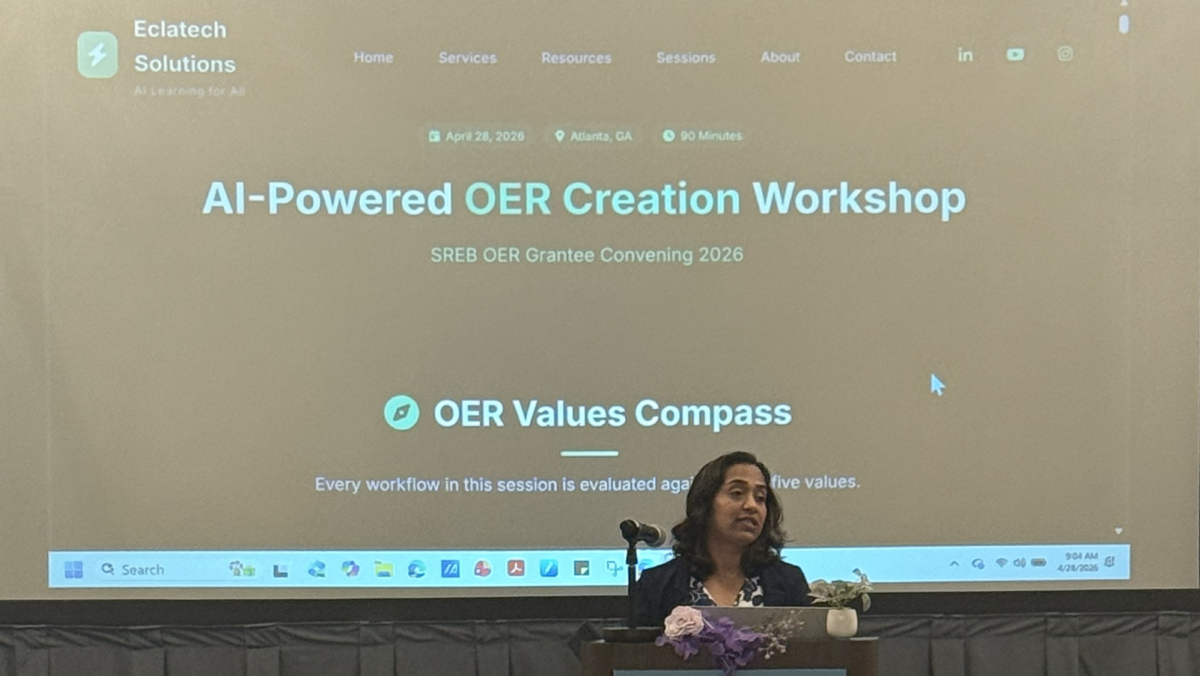 The AI-Powered OER Workshop
delivered by Bhavani Kola was overall regarded as the event
highlight. Many grantees cited it as the most valuable session,
noting that the AI tools and data capture concepts were
immediately applicable to their work. Kola’s AI-Powered OER
session offered participants potential solutions to critical
questions on AI and OER, an OER-AI evaluation rubric, prompt
templates to support AI-powered OER creation, accessibility
checking resources, and several powerful tools for AI-powered OER
creation.
The AI-Powered OER Workshop
delivered by Bhavani Kola was overall regarded as the event
highlight. Many grantees cited it as the most valuable session,
noting that the AI tools and data capture concepts were
immediately applicable to their work. Kola’s AI-Powered OER
session offered participants potential solutions to critical
questions on AI and OER, an OER-AI evaluation rubric, prompt
templates to support AI-powered OER creation, accessibility
checking resources, and several powerful tools for AI-powered OER
creation.
Of particular interest were the prompt templates and the OER Builder, a tool for generating AI-powered resources to support classes using OpenStax textbooks. Attendees especially enjoyed the opportunity to experiment with the provided prompt templates as they consider how to use AI for their own OER creation needs.
Rose-Bud-Thorn Garden Walk
The Rose-Bud-Thorn Garden Walk poster session included posters developed by each grantee team. It was celebrated by grant teams as a strong reflection framework for processing ideas, celebrating successes, evaluating opportunities and discussing challenges with peers.
Laredo College’s poster was regarded as particularly well-liked in both design and content. Grantees had several comments and questions for their team during the open forum part of the poster session, particularly about how they obtained administrative support for their OER work.
Open Education Sustainability Workshop
Attendees considered the Open Education Sustainability Workshop delivered by Tiffani Tijerina a crucial strategy driver. They noted that the session provided much-needed space to think critically about long-term project viability and institutional permanence. Tiffani encouraged grantees to view their open education sustainability plans through three lenses: technical infrastructure, financial ecosystem and identification of community champions. As a result, grant teams strategized the sustainability needs of their projects and institutions.
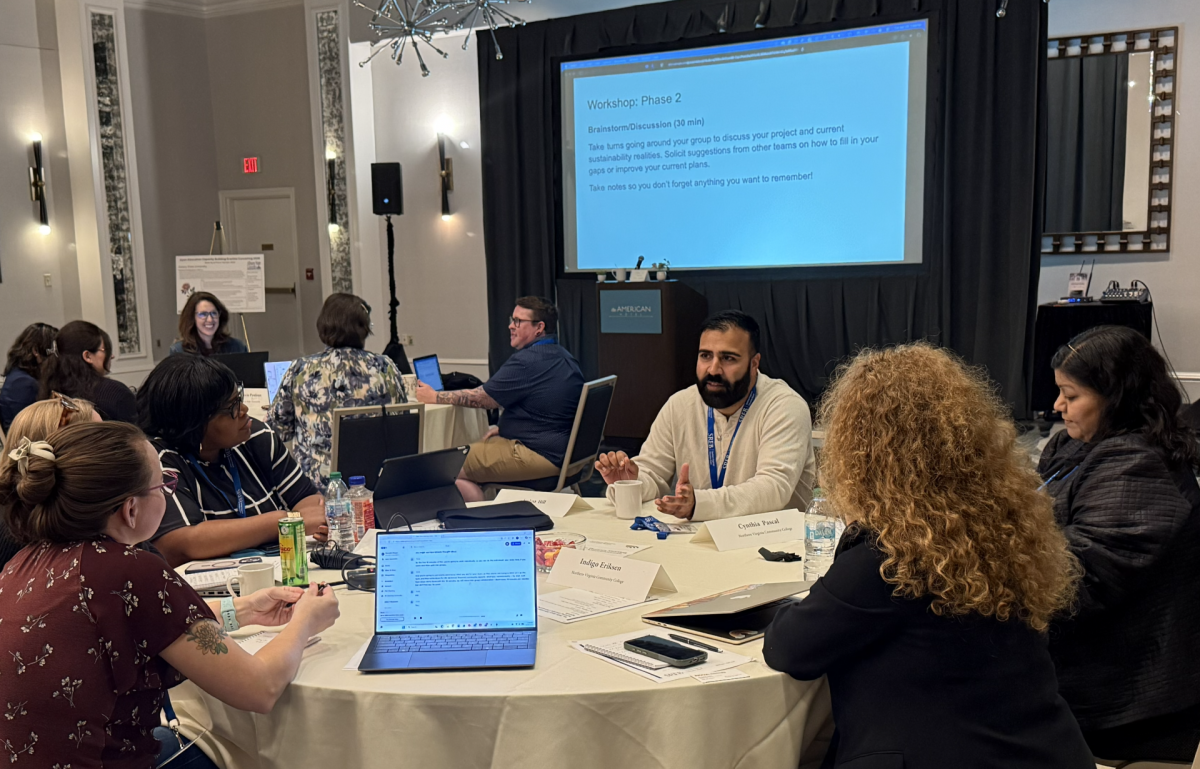 This workshop presented an
opportunity for participants to collaborate directly with
participants of other grant teams. Many expressed appreciation
for the opportunity to learn from other teams about how they are
approaching sustainability and to solicit advice for their own
sustainability challenges.
This workshop presented an
opportunity for participants to collaborate directly with
participants of other grant teams. Many expressed appreciation
for the opportunity to learn from other teams about how they are
approaching sustainability and to solicit advice for their own
sustainability challenges.
One SREB grantee shared,
“The highlight from this convening was getting to learn from peer institutions. I did not expect to get so much information and tools I could apply to my own work. I also very much enjoyed the detail that went into selecting the location.”
SREB brings states together to work collectively on open education initiatives that would not be possible alone. The work shared during the 2026 Open Education Capacity Building Grantee Convening demonstrates a community that’s moving past isolated experiments toward building a more resilient infrastructure. Thank you to the William and Flora Hewlett Foundation, presenters and grantees for making this progress possible.
For questions or to learn more about future grant opportunities, please contact us.