

Investing Early in Teachers Pays Dividends for Everyone

Imagine a financial investment that pays off not just for the investor, but for the entire community. Now imagine that investment isn’t in stocks or bonds, but in people — specifically, teachers at the beginning of their careers. If states and districts treated early-career teacher support like a high-yield asset, the returns — in student achievement, economic growth and public savings — are both measurable and substantial.
This isn’t just a sentiment. The numbers back it up.
Why Early Investment in Teachers Matters
About 20% of teachers leave the profession within their first year, and nearly 50% are gone by year five. This churn is costly. Recruiting, hiring and onboarding a new teacher can cost districts thousands of dollars per vacancy. But when districts invest early — with structured induction programs, mentoring and reduced teaching loads — they’re more likely to keep teachers in classrooms long enough to become effective. And when teachers stay, students win big.
Research shows that new teachers who receive more hours of mentoring see higher gains in student reading and math performance. These academic gains aren’t abstract — they translate into higher student attendance, satisfaction with school and even a greater likelihood of college readiness and attendance.
The ROI: Numbers You Can’t Ignore
Let’s talk about return on investment. That’s where the case for early-career teacher support gets compelling.
A 2022 analysis from the Washington State Institute for Public Policy crunched the numbers on induction and mentoring programs. Here’s what they found per participating teacher:
- Total benefits: $7,466 per participant
- Net program cost: just $90/teacher
- Benefit-to-cost ratio: an astonishing $82.91/teacher
- Probability of producing a net benefit: 64%
In another example from California, researchers found that a five-year investment in comprehensive teacher induction yielded a return of nearly $8,600 per teacher for the state. The gains went beyond retention — they factored in student achievement and the long-term cost savings of avoiding repeated hiring cycles.
Who benefits from this investment? Taxpayers, teachers, students and communities.
The Compounding Effect for Students
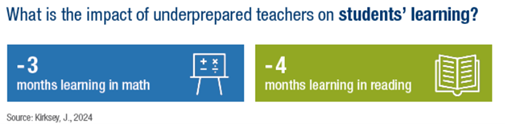
When students have the stability of high-quality teachers year over year — especially early in their educational journey — the benefits compound over time. Students taught by effective teachers are more likely to graduate high school, attend college and earn higher incomes as adults.
A 2023 SREB-Vanderbilt study adds another critical layer: teachers who enter through traditional preparation routes are more likely to stay in the classroom. Those with strong prior experiences and mentorship are also more effective — and effectiveness, especially in early grades, has a long-lasting impact. One landmark study found that having just one high-performing teacher in elementary school can increase a student’s lifetime earnings by $25,000.
Now multiply that by 25 kids in a classroom — and by the hundreds of students a teacher impacts over a career. Investing a few thousand dollars up front to support that teacher becomes a no-brainer.

High-Risk Teachers Deserve High Support
Not all early-career teachers face the same odds. Those teaching in high-poverty schools, low-performing schools, or schools with fewer white students have a higher risk of leaving. Teachers in secondary grades also tend to leave more often than their elementary counterparts.
If we know where the risks are highest, we also know where investments can be most powerful. Induction programs must be customized because the context matters. A cookie-cutter program won’t be effective. Districts and states should design supports that include:
- Well-trained and supported mentor teachers
- Time to collaborate and observe others
- Relevant, job-embedded professional development
- Supportive administrators
- A reduced teaching load for novice teachers
States like New Mexico have gone a step further by requiring annual evaluation of induction and mentoring to ensure quality and effectiveness — an approach every state can emulate.
The Bigger Picture: Savings for States and the Public
This isn’t just about schools — it’s about the broader economy. Every teacher retained means thousands of public dollars saved, students better prepared for the workforce, and stronger local economies. A well-educated population means lower crime rates, reduced dependence on social services, and a more skilled workforce — all of which help states balance their budgets.
When you look at the data, it’s clear: early investment in teachers is a fiscally responsible policy. The up-front cost of induction programs is dwarfed by the long-term savings and benefits.
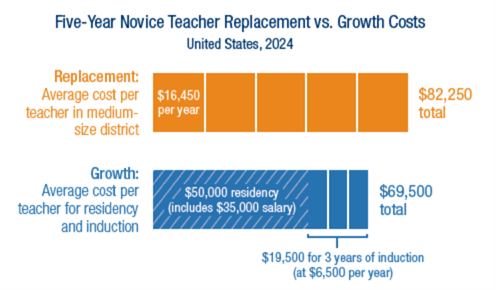
Based on average national replacement costs and residency costs, SREB has calculated a $12,750 average savings of over five years for medium-sized districts by growing and supporting novice teachers rather than replacing the novice teachers that leave annually.
Final Thought: Be the Investor Education Needs

We would never suggest pulling financial investments after one year — yet that’s often the treatment for teachers. Often leaders expect immediate results and offer limited support, then act surprised when teachers leave.
If we treated early-career teachers like long-term investments — with structured support, mentorship, and the time to grow — we’d see the returns grow exponentially. For students. For schools. For taxpayers. For all of us.
Let’s invest early. The dividends are undeniable.
_____________
See our research on teacher induction
See our research on new teacher retention
See SREB’s Teacher Induction Resources and Framework
SREB can help your state develop strong guidance on induction or help your district and schools create or improve a system of induction support for teachers. Contact Us