SREB Labor Market Data Hub
Connect education to local careers
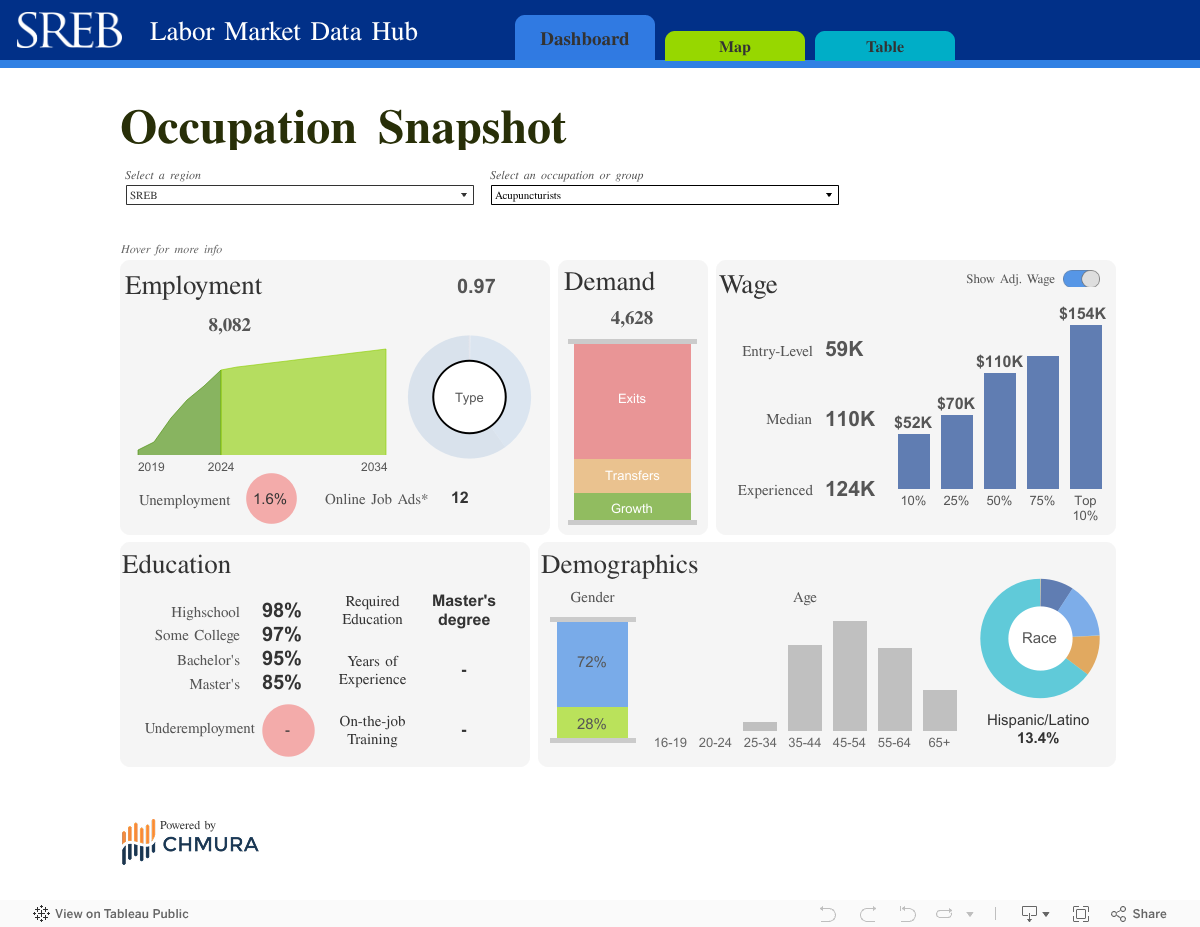
SREB offers the Labor Market Data Hub to help schools and colleges connect labor market data to education programs across our 16 Southern states. This dashboard features detailed occupational data from JobsEQ for each state and workforce region. Find sources, definitions and more below the dashboard.
This tool is better viewed on computer than on mobile device.
Purpose & Overview
SREB designed the Labor Market Data Hub to improve the availability of labor market information for schools, districts and colleges across our 16 Southern states. This dashboard features detailed occupational data for each state and workforce region designated by the Workforce Innovation and Opportunity Act.
Navigating the Dashboard
The SREB Labor Market Data Hub is organized into three views: Dashboard, Map and Table.
Dashboard View
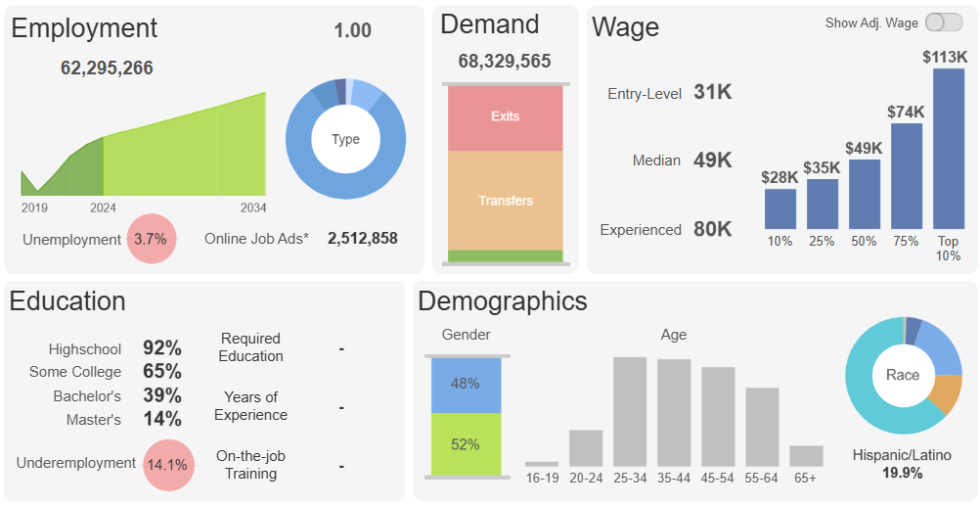
Displays detailed data for one occupation in one region. It can be used to gain an in-depth understanding of an occupation’s employment characteristics, forecasts, wage potential and demographics of the people currently employed in the occupation.
Map View
Makes it easy to understand how one occupation differs between states and workforce regions by total employment, growth forecasts and other characteristics.
Table View
Allows for a quick comparison between multiple occupations in the same state or workforce region.
All views offer download options including image and data.
Sources and Definitions
This dashboard uses data from JobsEQ, a labor market analytics platform developed by Chmura.
The most recent annual data is from 2024.
Employment
Employment data is from the U.S. Bureau of Labor Statistics Quarterly Census of Employment and Wages. Where the BLS does not provide state and local data, JobsEQ imputes it.
Forecasted employment growth uses national projections from the Bureau of Labor Statistics, adapted for regional growth patterns by Chmura.
Occupation unemployment figures are imputed by Chmura from data provided by the BLS.
Online job ads are from a data set produced by Chmura from over 40,000 websites. The data is for a 30-day window ending on Aug. 19, 2025.
Demand
Employment and demand forecasts are developed by Chmura at the county level based on national and state forecasts. Forecasts are adjusted to reflect the region rather than the nation by considering the region’s unique industry or occupation mix and general overall growth expectations.
Regional employment growth expectations are modeled to be consistent with U.S. Census population forecasts, labor market commuting patterns and expected changes in participation rates over time.
Wages
Wage data utilizes Bureau of Labor Statistics Occupational Employment and Wage Statistics data, compiled by Chmura.
Entry-level wages are computed as the mean of the lower third of all wages.
Experienced wages are defined to be the mean of the upper two-thirds of wages.
Education
Education data are modeled by Chmura using U.S. Census Bureau Educational Attainment project along with source data from the Bureau of Labor Statistics.
Education requirements are assigned per the Bureau of Labor Statistics.
Demographics
Demographics by age, gender, race and ethnicity are modeled by Chmura based on employment and ZIP code level data from the 2019-2023 American Community Survey 5-Year Estimates.