Mississippi State Progress Report 2025
Mississippi
2025 State Progress Report
Middle Grades
Summary of middle grades
- The National Assessment of Educational Progress — also known as the Nation’s Report Card — measures student achievement every two years, most recently in 2024.
- Student achievement has shifted due to COVID-19 and its recovery efforts. Proficiency improved in several states since 2013, but that growth highlights challenges in education administration, particularly the gap along socioeconomic lines, English proficiency and those with disabilities.
- The roots of academic problems in the middle grades often extend back to children’s first years in school. Support that begins there and continues into the middle grades ensures that more students are prepared to move into high school.
- The Challenge to Lead 2020 goal for middle grades emphasizes the need for SREB states to close NAEP performance gaps between student groups. Policies that help all students meet standards and reach higher academic levels are crucial.
- Too few eighth graders in all SREB states are meeting benchmarks that put them on track for successful academic careers.
- Helping students rise from Basic to Proficient on NAEP is critical, but it often requires helping them improve from below Basic to Basic.
- Many of these results are due to falling scores nationwide amongst all students, rather than closing the gap between student groups.
Longitudinal Benchmarks for States
The percentages of eighth graders in both the nation and SREB region scoring at or above the NAEP Basic level were drastically lower in 2024 than in 2013. In reading, these rates dropped by 10.8 points for the nation and 11.2 points for the region. In math, they dropped by 14.2 points and 15.1 points. Together, these changes mean that the number of students performing at the Basic level or below in 2024 grew compared to 2013.
Fewer percentages of eighth graders performed at or above the Proficient level in 2024 than in 2013. In reading, these students declined by 5.6 points in the nation and 5.3 points in the SREB region; in math, it declined by 7.6 points in the nation and 7.5 points in the region.
summary of reading
- Each state in the SREB region experienced declining reading performance at or above the Basic level from 2013 to 2024, which follows the national trend of most states experiencing declining performance.
- Only Louisiana and Mississippi in the SREB region experienced improved reading performance at or above the Proficient level from 2013 to 2024.
- The gap between the percentage of white students in SREB states and their Black peers meeting the Proficient benchmark fell between 2013 and 2024; however, all racial groups experienced declines. The gap also grew between white eighth graders and their Hispanic peers.
- In 2024, smaller percentages of eighth graders from low-income families in SREB states met either benchmark than their regional peers. In the SREB region, the gap in performance on NAEP between students from low-income families and their peers remained constant at the Proficient benchmark.
- English learners in SREB states no longer outperformed their national eighth grade peers at both performance benchmarks in 2024.
- Gaps grew between groups at the Basic level but declined at the Proficient level.
- Eighth graders with disabilities in SREB states did not do as well as their national peers on the NAEP Basic level in 2024. The percentages of eighth graders with disabilities meeting Basic and Proficient benchmarks on NAEP declined from 2013 to 2024. The gaps between these students and their peers fell at the Proficient benchmark due to falling test scores nationally.
- While 26% of eighth graders in the median SREB state performed at or above the Proficient level on NAEP in 2024, another 37% fell below Basic. These students did not demonstrate partial mastery of grade-level skills. They are far from being prepared for high-school level subjects and are likely to struggle, even with extra support.
- Overall percentages of eighth graders performing below Basic on NAEP obscure large gaps between student groups. In 2024, much larger proportions of Black and Hispanic eighth graders fell below the Basic benchmark on NAEP than their white and Asian peers.
Reading Performance by Race/Ethnicity
In 2024, Asian eighth graders in the SREB region outperformed their peers on NAEP. White eighth graders outperformed their Black and Hispanic peers. Among all students, over one-third (36%) are below Basic. This number has risen over time, wiping out the educational gains achieved from 2000 to 2019.
Asian and Hispanic students in the SREB region are outperforming their peers nationwide; however, white and Black students are below the national average. A majority of Black students in the region (52%) are not reading at or above Basic, while 44% of Hispanic students are meeting that same metric. White (27%) and Asian students (14%) account for the other racial/ethnic groups represented.
Since 2015 all racial/ethnic groups in the SREB region have held relatively consistent reading scores (within four percentage points) at or above the Proficient level. Only Asian students are performing better over that time.
Reading Performance by Student Group
Differences in the percentages of two student groups performing at a given level on NAEP are an indicator of how states are doing at supporting students who face additional barriers to learning. Among all students, over one-third (36%) are below Basic. This number has risen over time, wiping out the educational gains achieved from 2000 to 2019.
A significant majority of English learners (72%) and students with disabilities (70%) are reading at the below Basic level. Fewer than 8% of these students are reading at or above Proficient. Low-income eighth graders are performing closer to the regional average; however, almost half (47%) of these students are not reading at or above the Basic level.
From 2013 to 2024, the percentage of all students reading at or above the Proficient level has decreased by five points. Although the decline has not been as large among student groups, low-income eighth graders and English learners meeting this benchmark has fallen by two and three percentage points, respectively. However, students with disabilities have climbed one percentage point from 7% to 8% over that time. This percentage is still exceptionally low.
summary of math
- Each state in the SREB region experienced declining math performance at or above the Basic level from 2013 to 2024, which follows the national trend of most states experiencing declining performance.
- Only Louisiana, Mississippi and Tennessee saw small gains in math performance at or above the Proficient level from 2013 to 2024.
- The gaps increased between white and Black eighth graders at both levels in the SREB region. The gap increased more between white and Hispanic eighth graders performing at Proficient or above. The gap between Asian and white students grew at the Basic level but not the Proficient level from 2013 to 2024.
- In 2024, smaller percentages of eighth graders from low-income families in SREB states met either benchmark than their regional peers. In the SREB region, the gap in performance on NAEP between students from low-income families and their peers grew at both the Basic and Proficient benchmarks.
- The region did not meet the Proficient benchmark at the same rate as their national peers in 2024 and met the Basic benchmark at a significantly lower rate since 2013.
- The gap between English learners and their peers in SREB states grew between 2013 and 2024 and at the Basic benchmark but declined at or above the Proficient level.
- Eighth graders with disabilities in SREB states did not do as well as their national peers on the NAEP Basic level in 2024. The percentages of eighth graders with disabilities meeting Basic and Proficient benchmarks on NAEP declined from 2013 to 2024. The gaps between these students and their peers fell at the Proficient benchmark due to falling test scores nationally.
Math Performance by Race/Ethnicity
In 2024, Asian eighth graders in the SREB region outperformed their peers on NAEP. White eighth graders outperformed their Black and Hispanic peers. Among all students, almost half (45%) are below Basic. This number has risen over time, wiping out the educational gains achieved from 2000 to 2019.
Only Asian students in the SREB region are outperforming their peers nationwide; however, Hispanic students in the region are matching pace with the nation. White and Black students are below the national average. A majority of Black (65%) and Hispanic students (54%) in the region are not performing at or above Basic. White (29%) and Asian students (10%) account for the other racial/ethnic groups represented. Students inside and outside of the region experience more academic struggles in middle grades math.
Since 2015 all racial/ethnic groups in the SREB region have seen math scores decline (ranging from two to ten percentage points) at or above the Proficient level. The largest drop off is amongst Asian students (10 percentage points), while the smallest is among white and Black students (two and three percentage points, respectively).
Math Performance by Student Group
Differences in the percentages of two student groups performing at a given level on NAEP are an indicator of how states are doing at supporting students who face additional barriers to learning. Among all students, almost half (45%) are below Basic. This number has risen over time, wiping out the educational gains achieved from 2000 to 2019.
A significant majority of English learners (81%) and students with disabilities (78%) are performing at the below Basic level. Fewer than 6% of these students are performing at or above Proficient. Low-income eighth graders are performing closer to the regional average; however, over half (56%) of these students are not performing at or above the Basic level.
From 2013 to 2024, the percentage of all students performing at or above the Proficient level has decreased by eight points. Although the decline has not been as large among some student groups, low-income eighth graders and English learners meeting this benchmark has fallen by four and six percentage points, respectively. However, students with disabilities have dropped by eight percentage points over that time.
Early Grades
summary of early grades
- The National Assessment of Educational Progress — also known as the Nation’s Report Card — measures student achievement every two years, most recently in 2024.
- Student achievement has shifted due to COVID-19 and its recovery efforts. Proficiency improved in several states since 2013, but that growth highlights challenges in education administration, particularly the gap along socioeconomic lines, English proficiency and those with disabilities.
- Most SREB states struggled to overcome education loss amongst students at or above Basic level.
- The Challenge to Lead 2020 early grades goal emphasizes the need for SREB states to close NAEP performance gaps between students of racial and ethnic groups, between students from low-income households and those whose families earn higher incomes, and between English learners and their peers.
- Performance gaps are an indicator of how states are doing at supporting students who face additional barriers to learning. Policies that help all students meet standards and reach higher academic levels are crucial.
- Too few fourth graders in all SREB states are meeting benchmarks that put them on track for successful academic careers.
- English learners often enter school with little to no exposure to the English language and struggle in U.S. classrooms, especially in subjects that are reading dependent. This group is projected to account for an increasing proportion of enrollments in SREB states in the immediate future.
- Helping students rise from Basic to Proficient on NAEP is critical, but it often requires helping them improve from below Basic to Basic.
- Many of these results are due to falling scores nationwide amongst all students, rather than closing the gap between student groups.
Longitudinal Benchmarks for States
Smaller percentages of fourth graders scored at or above the NAEP Basic level in 2024 than in 2013 in both the nation and SREB region. In reading, these figures dropped by 7.9 points for the nation and 7.1 points for the region; in math, they dropped by 6.7 points and 7.6 points. Together, these changes mean that the group of fourth graders performing at the Basic level in 2024 shrank compared to 2013, while the gaps between students based on income, English-language ability, and race/ethnicity increased because of the COVID-19 pandemic and its recovery efforts.
The percentages of students performing at or above Proficient also fell over the same period — by 3.5 points for the nation and 2.0 points for SREB states in reading, and by 1.9 points for the nation and 1.5 points for the region in math.
summary of reading
- Only two states in the SREB region improved their reading performance at or above the Basic level from 2013 to 2024, which follows the national trend of most states experiencing declining performance. These states are Louisiana and Mississippi.
- Only Louisiana, Mississippi and South Carolina in the SREB region experienced improved reading performance at or above the Proficient level from 2013 to 2024.
- The gaps between the percentages of white and Asian students in SREB states and their peers meeting the Proficient benchmark fell between 2013 and 2024.
- In 2024, fourth graders from low-income families in SREB states performed at or above the Basic and Proficient benchmarks at similar rates as their national peers. However, there is still a gap in performance on NAEP between these two groups for both benchmarks.
- In 2024, English learners in SREB states met the Basic benchmark at a slightly higher rate than their national peers. The gap between English learners and their peers in SREB states between 2013 and 2024 remained for both performance benchmarks.
- Despite steady enrollments, demographic changes and the persistence of achievement gaps, some SREB states made promising gains in achievement between 2013 and 2024. Fourth graders in Louisiana and Mississippi made considerable progress at both benchmark levels.
- While 30% of fourth graders in the median SREB state performed at or above the Proficient level on NAEP in 2024, another 41% fell below Basic. These students did not demonstrate partial mastery of grade-level skills. They are far from the target benchmark and are likely to struggle in future grades even if they receive extra support.
- Overall percentages of fourth graders performing below Basic on NAEP hide large gaps between student groups. In 2024, much larger proportions of Black and Hispanic fourth graders fell below the Basic benchmark on NAEP than their white and Asian peers.
Reading Performance by Race/Ethnicity
In 2024, Asian fourth graders in the SREB region outperformed their peers on NAEP. White fourth graders outperformed their Black and Hispanic peers. Among all students, over two-fifths (41%) are below Basic. This number has risen over time, wiping out the educational gains achieved from 2000 to 2019.
Black, Hispanic and Asian students in the SREB region are narrowly outperforming their peers nationwide, while white fourth graders are even with the national average. A majority of Black (55%) and Hispanic students (52%) in the region are not reading at or above Basic. White (31%) and Asian students (20%) account for the other racial/ethnic groups represented.
Since 2015 all racial/ethnic groups in the SREB region have seen reading scores decline (ranging from one to five percentage points) at or above the Proficient level. The largest drop off is amongst white and Asian students (five percentage points), while the smallest is among Black and Hispanic students (one percentage point each).
Reading Performance by Student Group
Differences in the percentages of two student groups performing at a given level on NAEP are an indicator of how states are doing at supporting students who face additional barriers to learning. Among all students, over two-fifths (41%) are below Basic. This number has risen over time, wiping out the educational gains achieved from 2000 to 2019.
A significant majority of English learners (69%) and students with disabilities (75%) are reading at the below Basic level. Fewer than 9% of these students are reading at or above Proficient. Low-income fourth graders are performing closer to the regional average; however, over half (53%) of these students are not reading at or above the Basic level.
From 2013 to 2024, the percentage of all students reading at or above the Proficient level has decreased by two points. Although there has been no decline among some student groups, English learners (9%) and students with disabilities (9%) are still struggling. Low-income fourth graders that meet this benchmark have fallen by two percentage points.
summary of math
- Thirteen states in the SREB region experienced declining math performance at or above the Basic level from 2013 to 2024, which follows the national trend of most states experiencing declining performance. Alabama, Louisiana and Mississippi improved their performance.
- Nearly half of all SREB states improved gains in math performance at or above the Proficient level from 2013 to 2024, although the SREB median remained in decline.
- The gap between white and Black students shrank although it is still large, but it grew between white and Hispanic and white and Asian students.
- In 2024, fourth graders from low-income families in SREB states performed at or above the Basic and Proficient benchmarks at similar rates as their national peers, with the exception being the region’s overperformance compared to the nation. However, there is still a gap in performance on NAEP between these two groups for both benchmarks.
- In 2024, English learners in SREB states met the at or above Basic benchmark at a higher rate than their national peers. The gap between English learners and their peers in SREB states between 2013 and 2024 remained for both performance benchmarks.
- Despite steady enrollments, demographic changes and the persistence of achievement gaps, some SREB states made promising gains in achievement between 2013 and 2024. Fourth graders in Alabama, Louisiana and Mississippi made considerable progress at both benchmark levels.
Math Performance by Race/Ethnicity
In 2024, Asian fourth graders in the SREB region outperformed their peers on NAEP. White fourth graders outperformed their Black and Hispanic peers. Among all students, less than a quarter (24%) are below Basic. Early grades math has been an area of strength amongst students inside and outside of the region.
White and Asian students in the SREB region are outperforming their peers nationwide, while Black and Hispanic fourth graders are even with the national average. Among Black and Hispanic students, 39% and 32%, respectively, are not performing at or above Basic. White (13%) and Asian students (5%) account for the other racial/ethnic groups represented.
Since 2015 white and Asian fourth graders in the SREB region have seen math scores increase (five and ten percentage points, respectively) at or above the Proficient level. The only decline over time is amongst Hispanic students (two percentage points), while Black students have been consistent over that time.
Math Performance by Student Group
Differences in the percentages of two student groups performing at a given level on NAEP are an indicator of how states are doing at supporting students who face additional barriers to learning. Among all students, almost a quarter (25%) are below Basic. Early grades math has been an area of strength amongst students inside and outside of the region.
A majority of students with disabilities (52%) are performing at the below Basic level, while 46% of English learners are at this benchmark. These metrics have improved compared to other levels and subjects, but less than 25% of these student groups are performing at or above Proficient. Low-income fourth graders are performing closer to the regional average; almost one-third (32%) of these students are not performing at or above the Basic level.
From 2013 to 2024, the percentage of all students performing at or above the Proficient level has decreased by two points. Although the decline has not been as large among some student groups, low-income fourth graders and English learners meeting this benchmark still fell by one percentage point each. However, students with disabilities have increased by one percentage point over that time.
Early Learning
Summary of Pre-k enrollment
- The Challenge to Lead 2020 goals call for all children entering school to exhibit the knowledge and skills needed for success in first grade. This goal can be achieved by increasing access to pre-K and kindergarten and ensuring the quality of these programs.
- If young children experience high-quality early learning programs, they are more likely to enter first grade ready to learn, and their chances for success throughout school are greatly improved.
- The SREB region has historically led the nation in pre-K access for 4-year-olds. Between 2014 and 2024, the percentage of 4-year-olds enrolled in state-funded pre-K rose in seven SREB states.
- However, enrollment declined in seven states for state-funded pre-K during the 2023-24 school year. Nationally, 37% of 4-year-olds were enrolled.
Publicly Funded Pre-K Enrollment
As expectations for later grades increase, so has the importance of pre-K and kindergarten as a transition point to help young children build on pre-K education and be prepared for success in elementary school and beyond.
Publicly funded pre-K consists of state funds, as well as those from Head Start, special education, and local funds. Nine states had a majority of 4-year-olds enrolled in publicly funded pre-K, while five states had a supermajority (60% or more) of students enrolled. Head Start and special education funds made up about 9% of publicly funded pre-K. The SREB median for state funds was about 36%.
summary of pre-k Standards
- States in the SREB region still face the challenge of providing earlier access to pre-K programs. While access to pre-K is important, quality is the key to achieving lasting gains for young children.
- The National Institute for Early Education Research (NIEER) has identified 10 standards of quality for pre-K programs. Aspects of structural quality include class size limits, low child-to-staff ratios and state monitoring requirements.
- NIEER has also identified aspects of process quality, which include learning standards aligned through grade three, regular classroom observations and well-qualified teachers who receive ongoing coaching.
- The minimum number of instructional hours for full-day kindergarten programs varies widely across SREB states — from as few as 680 annual hours to as many as 1,260.
- Researchers also find benefits for smaller class sizes in the earliest school years. The median SREB state allowed no more than 22 kindergartners per teacher.
Teacher Quality Benchmarks
The 2020 goals emphasize strong teacher qualifications and continuous professional development for early learning teachers. Research shows that students with pre-K teachers who have a bachelor’s degree and specialized training in early childhood education have better outcomes. Assistant pre-K teachers need the Child Development Associate credential. Ongoing, hands-on professional development — at least 15 hours per year — and coaching are also important for all classroom teachers.
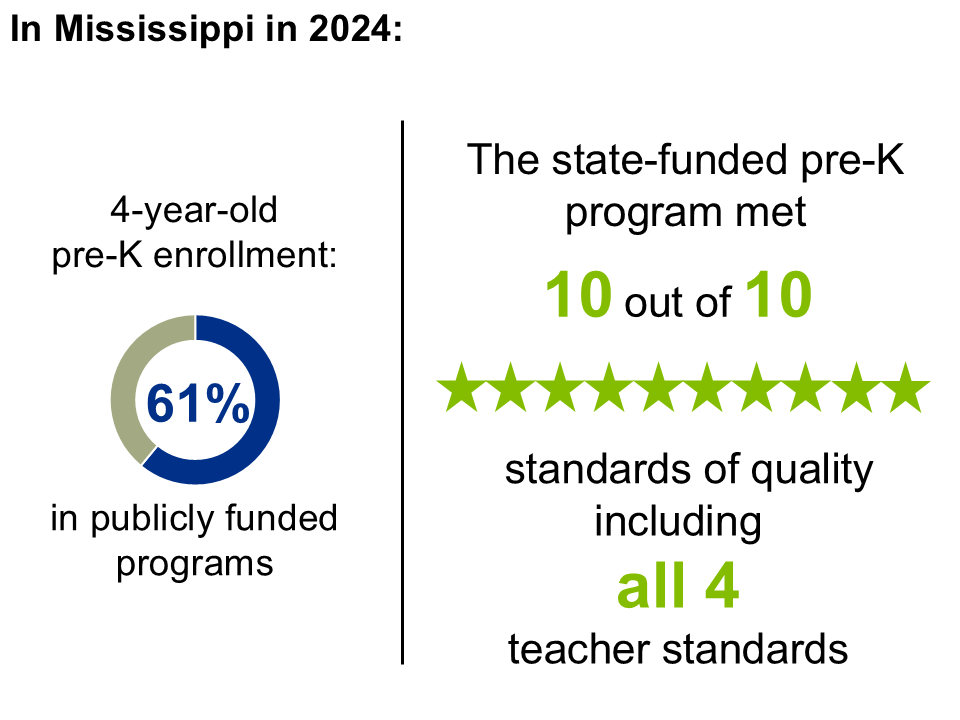
Four of the 10 NIEER standards of quality identify minimum requirements for early learning teachers. Alabama, Georgia and Mississippi were among just six states in the nation that met the four NIEER teacher qualification standards in 2023-24.
Early Learning Key Points
Alabama and Mississippi are two of only five states nationwide that met all 10 of NIEER’s standards in the 2023-24 school year; another five programs in SREB states met nine of these standards. Seven SREB states have increased enrollment in state-funded pre-K since the 2013-14 school year. In addition, nine states in the region have more than half of 4-year-olds enrolled in pre-K.
In May of 2026, NIEER published its most recent State of Preschool Yearbook; this data will be reflected in the next State Progress Report. Georgia’s state-funded pre-K program was recognized for meeting all 10 of NIEER’s standards for the 2024-2025 school year.
Demographics
summary of pk-12 enrollment and demographics
- The Challenge to Lead goals have always been ambitious by targeting high achievement for all groups of students, while emphasizing the need to shrink achievement gaps.
- Efforts to meet these goals must address falling enrollment and dynamic population changes: fewer students in public schools, more families struggling economically and more children whose primary language is not English.
- The SREB region has been home to more than a third of the nation’s population for decades and continues to grow. Growth in the region represented more than half of the nation’s total population growth between 2018 and 2024.
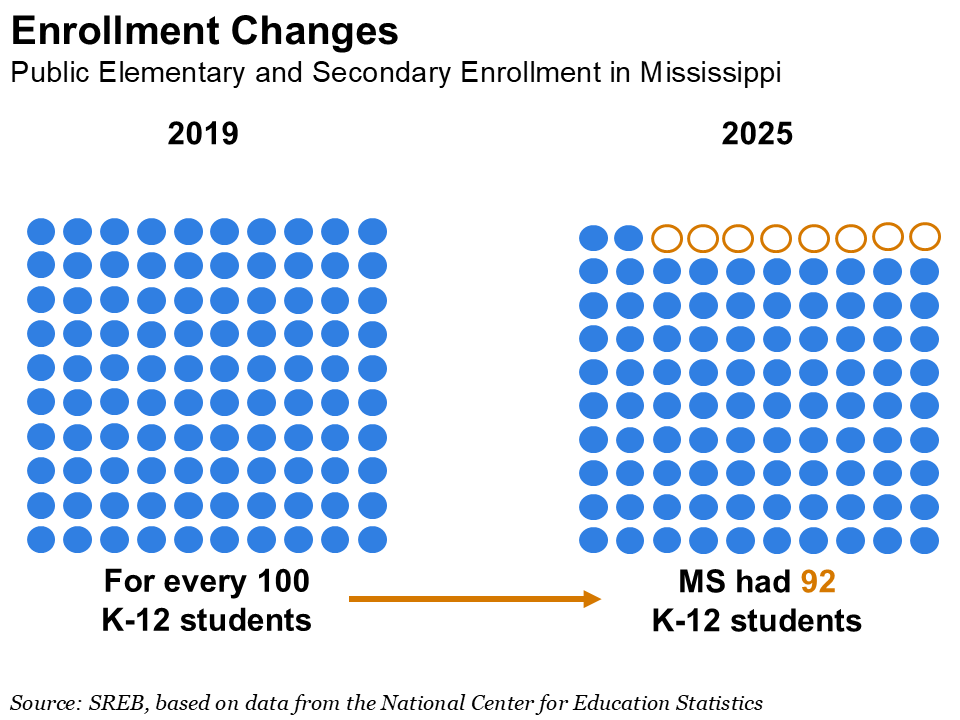
- The overall population in SREB states rose 4% from 2018 to 2024, so it is surprising that public elementary and secondary school enrollment fell. Enrollment in SREB states decreased by almost 0.2% over this period, but enrollment fell nationwide by almost 3%.
PK-12 Enrollment
Six SREB states had higher enrollment in fall 2024 than in fall 2018. The other 10 states saw enrollment decline. The changes ranged from a 3% increase to a 10% decrease. More students mean more schools, teachers, buses and books — larger education budgets just to meet the growing demand for basic education services. Fewer students mean less funding. Public school enrollment has fallen nationally and in the SREB region over the last two years, which continues a trend of declining enrollment since the national peak of almost 51 million students in 2018. The region’s enrollment peaked in 2022 with just under 20 million students.
Public school enrollment has seen increased diversity over the past decade. In fall 2024, 44% of public pre-K-12 students in the United States were white — down six points from fall 2014. The proportion of Black students also declined slightly to 15%. However, the proportions of Asian and Hispanic students rose over the 10-year period, to 6% and 29%, respectively. Racial and ethnic diversity also increased in SREB states between 2014 and 2024. In fall 2024, American Indian, Asian, Black and Hispanic students made up more than half (61%) of public-school enrollment in the SREB region. Hispanic students, the fastest-growing group, increased as a proportion of student enrollment in the region by almost five points during this time.
Children Living in Poverty
Schools must address the barriers to learning experienced by different and diverse groups of students. For example, children growing up in households whose incomes are near or below the poverty line face an increased likelihood of poor outcomes, including academic struggles. Research indicates that low family income can cause frequent family relocation and lead to higher absenteeism, disrupting student learning. It can also result in low-quality nutrition, inadequate health care and weak family engagement with schools — all factors that affect student achievement.
While child poverty rates have fallen since the Great Recession, over 11 million children under 18 years old in the United States lived in poverty in 2024 — about 15% of all children in the population. More than 44% of all children living in poverty in the nation resided in SREB states. The good news is that the percentages of children living in poverty decreased from 2015 to 2024 in both the nation and the SREB region. This percentage fell in all 16 SREB states. However, 12 SREB states still had higher childhood poverty rates than the national average in 2024. These rates ranged from 11% to 25% of all children in states across the region.
Key Points for Demographics
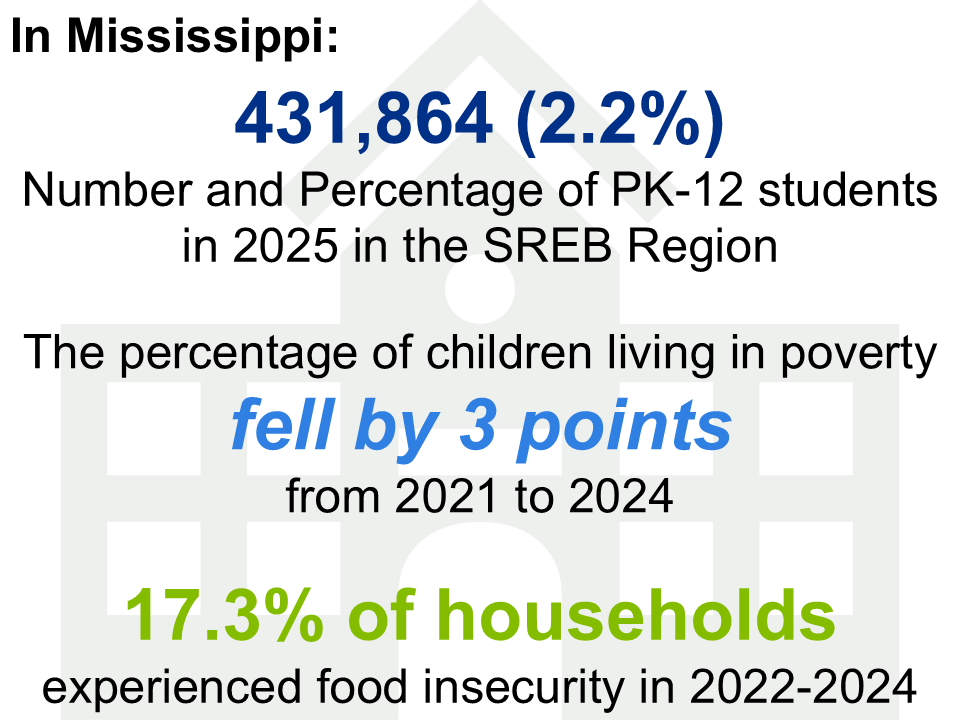
The Challenge to Lead Goals emphasizes student achievement through more than just academic performance. Poverty/Food insecurity plays a vital role in the outcomes of students. Overall, the percentage of children living in poverty in the SREB region fell by two points from 2021 to 2024. Food insecurity has risen across the nation since 2021. In the region, almost 19,750,000 students are enrolled in public schools in 2025, which represents 40% of all students nationally.