South Carolina State Progress Report 2026
South Carolina
2026 State Progress Report
Workforce
Summary of Workforce Prep
- Helping adults earn a postsecondary certificate or degree is vital to preparing the SREB region’s workforce for the future.
- The percentage of working-age adults with at least some postsecondary education increased over the last decade.
- The overall employment rate increased across most SREB states at all education levels.
- By 2030, every SREB state will have more dependent-age individuals than working age adults.
- Adults with higher credentials are less likely than their peers with less than a high school education to earn wages below the poverty threshold.
Educational Attainment
Helping adults earn a postsecondary certificate or degree to prepare for employment is imperative for states. Rapid advancements in automation and artificial intelligence will increasingly displace adults with low levels of education, transforming some positions while eliminating others. Better-paying careers in the coming years will require students to earn a certificate or degree after high school.
In the SREB region, the percentage of working-age adults with at least some postsecondary education increased 7.5 points between 2014 and 2024. But across the region in 2024, 37% of working-age adults still had a high school diploma or less.
Job Share by Education Level
The share of jobs held by adults with a high school diploma or less in the SREB region between 2014 and 2024 decreased by 1.1 points, while the share held by adults with a bachelor’s degree or more increased by 7.1 points.
Employment Rates by Education Level
Despite fewer low-skilled adults in the workforce in 2024 than in 2014, there was an overall employment rate increase across most states at all education levels over the decade. In fact, employment rates for adults with high school credentials increased in all SREB states over the 10-year period, by 3.9 points. In all 16 SREB states, adults with a bachelor’s degree or higher were employed at greater rates in 2024 compared to 2014.
These shifts point to a dire situation for low-skilled adults — those with a high school diploma or less — who are most vulnerable to technological advancement and economic downturns.
Working-Age Adults vs. Dependent Population
Technological progress and low educational attainment in the workforce are not the only challenges facing states. By 2030, every SREB state will have more dependent-age individuals than working-age adults.
Percentage of Adults in Poverty by Attainment
Between 2014 and 2024, poverty rates for adults with any postsecondary education decreased in 12 SREB states. For adults with a high school diploma or less, poverty rates decreased in 12 SREB states.
Earnings by Education Level
Adults with higher credentials are less likely than their peers with less than a high school education to earn wages below the poverty threshold — $15,960 for an individual with $5,680 for each additional person in 2026. In the median SREB state, adults with some college or higher earned $26,477 more than those with a high school diploma or less.
With the disruption of the pandemic, along with technological advancement shifts, SREB states are facing considerable challenges in meeting workforce needs.
With millions displaced and fewer high school graduates attending college, training for future job openings may become a necessity for 2030.
With fewer people attending and completing college, there are now millions displaced in the workforce pipeline who might need reskilling for future positions. States that coordinate thoughtful partnerships and strategic investments to attain degrees or skills will strengthen a thriving workforce in the future.
Summary of Workforce K-12
K-12 teacher shortages have plagued our region and nation for years, limiting districts and states from making crucial educational improvements. Teachers are the number one influence in educational achievement, yet these shortages are also severely limiting our ability to prepare the upcoming workforce, causing economical disadvantages. One workforce sector that is consistently overlooked — yet is integral to supplying workers in all other industries — is the teacher workforce.
The data below provides a picture of the teacher workforce, shortages and pipeline issues.
Quantity and Quality of Teachers
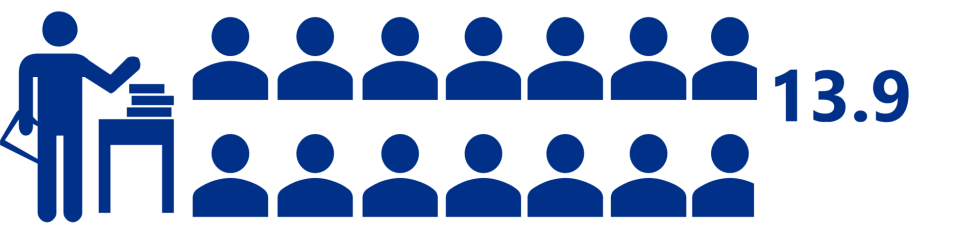
South Carolina’s pupil to teacher ratio in 2024 was 13.9.
Current and Future Teacher Shortages
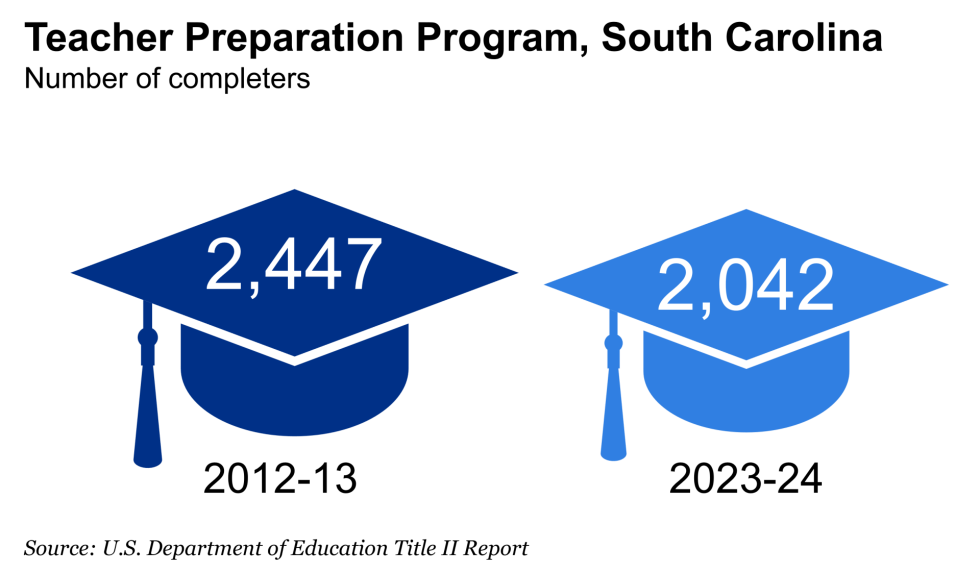
In the SREB region between the 2012-13 and 2023-24 school years, the number of teacher prep program completers decreased by 28%.
Teacher Salaries
Summary of Workforce Postsecondary
Shortages in postsecondary faculty in key fields are preventing technical, community and four-year colleges from supplying enough workers to meet demand in high-needs careers. While teacher shortages are affecting foundational skills preparation, postsecondary faculty shortages in high-demand disciplines are limiting the availability of skilled and ready workers to meet job demand in high-needs careers such as healthcare, information technology, education and other technical fields.
Key Faculty Shortages for In-Demand Career Fields
The data below highlights potential contributing factors and top faculty shortages.
Faculty Quantity and Quality
The data below highlights potential contributing factors and top faculty shortages.
Public Four-Year Colleges and Universities
At public four-year colleges and universities, South Carolina’s student to faculty ratio in 2024 was 16.

Public Two-Year Colleges
At public two-year colleges, South Carolina’s student to faculty ratio in 2024 was 16.

Faculty Salaries
Postsecondary
Postsecondary data will be available in summer 2026.
High School
Summary of High School Participation and Advanced Placement
- The percentage of ninth graders who reached 12th grade on time increased in the SREB region between 2014 and 2025.
- Between 2015 and 2023, 13 SREB states increased their high school graduation rates.
- In the SREB region, only 18% of the class of 2024 scored a 3 or higher on an AP exam during high school.
9th Grade Bulge and Grade-Level Progression
Making a successful transition from eighth to ninth grade is key to student success in high school. But this transition proves difficult for many students. In the SREB region, 109 ninth graders were enrolled in public schools in 2025 for every 100 eighth graders in 2024. The ninth-grade bulge ranged from three to 17 more students in ninth grade across all 16 SREB states.
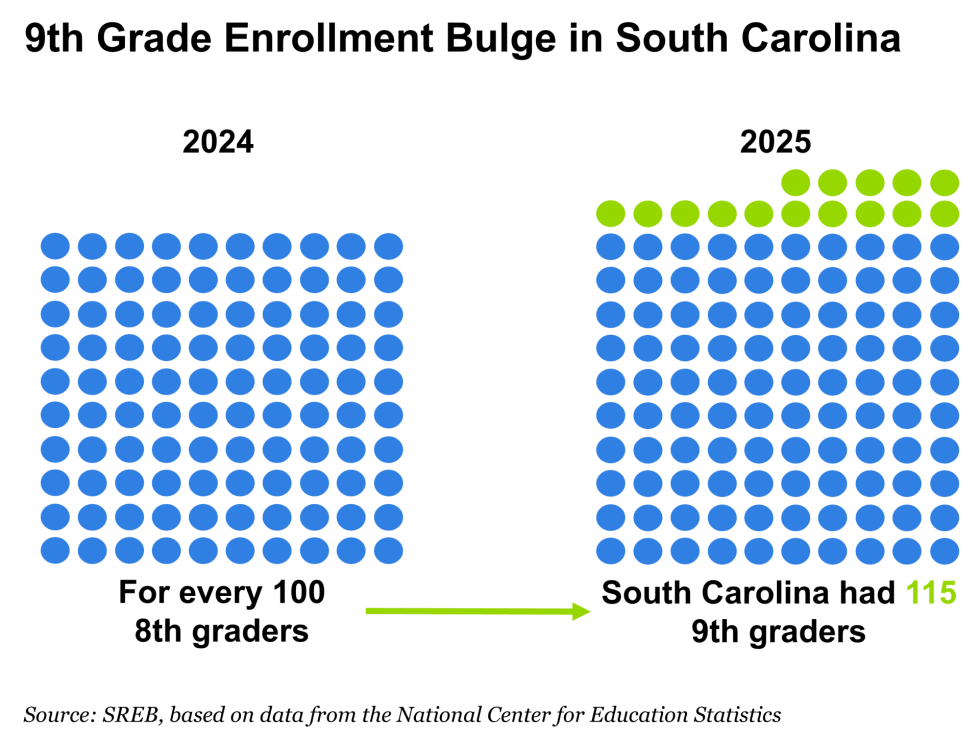
Students can struggle with transitions as they advance through high school as well, potentially putting them at risk of failing a grade or dropping out, although states have seen some improvement. From 2014 to 2025 the percentage of ninth graders who reached 12th grade on time increased 4 percentage points to 83%, trailing the nation by eight points. In 2025 the high school progression rates in SREB states ranged from 71% to 87%.
Several factors influence both the ninth-grade bulge and high school progression rates. Monitoring students’ progression into and through high school can help school staff identify students at risk of failure and show state leaders where state policies and programs can support student success.
Graduation Rate
Between 2015 and 2023, the region’s graduation rate rose by 3 points to 88%, one percentage point higher than the national average. Thirteen SREB states saw their high school graduation rates rise during this time, by one to 10 points. Amid overall gains in graduation rates, significant gaps remain among student groups. Black and Hispanic students, students with disabilities, those from low-income families, and English learners continued to graduate at rates lower than their Asian and white peers.
In 2023, 86% of Black students in SREB states graduated from high school, compared to 84% in 2019. Hispanic students graduated at a rate of 82%, compared to 84% in 2019.
At the same time, students from low-income families graduated from high school at a rate of 83%. English learners graduated at a rate of 69%, while students with disabilities graduated at a rate of 74%.
Advanced Placement
In addition to graduating students from high school, states need to focus on preparing students for a rapidly changing workforce. The Challenge 2030 goals call for states to increase access to accelerated programs, such as dual enrollment, Early College, International Baccalaureate and Advanced Placement.
For those students who take AP courses in high school and attempt the related exams, the research suggests that they are more academically successful as college freshmen. This is true even if the students do not earn a score of 3 or higher on the test — considered passing and generally sufficient to earn college credit.
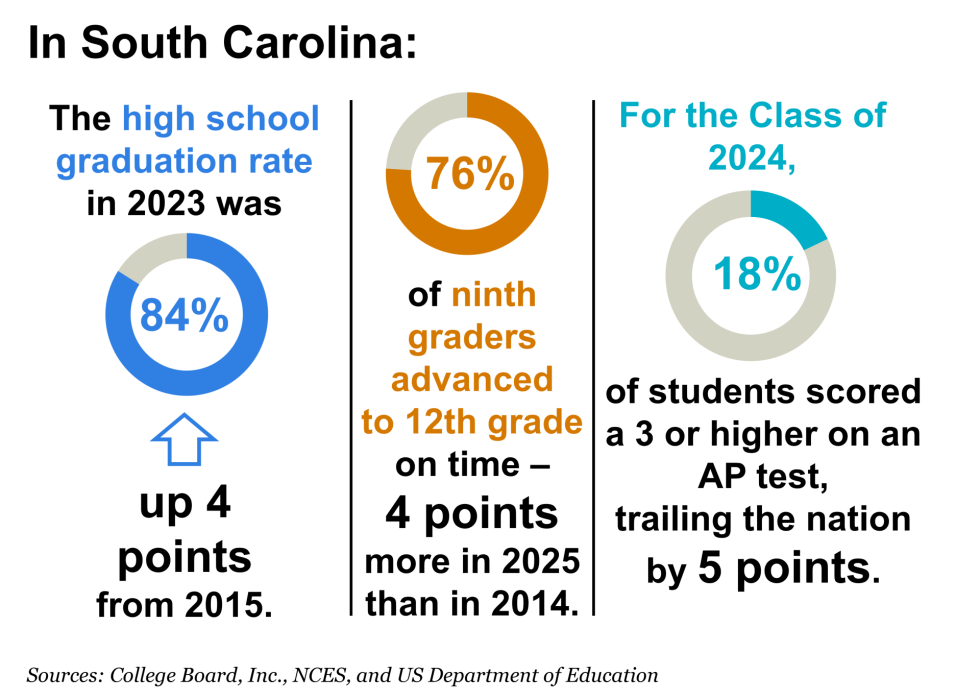
Nationally, 36% of the graduates in the Class of 2024 took an AP exam, compared to 19% to 46% across the SREB states. For students in the SREB states, passage rates ranged from 9% to 28%. Only three SREB states exceeded the national passage rate of 23%.
Summary of College and Career Readiness and ACT/SAT Participation and Performance
- Across the region, eight states had higher participation rates of the ACT and eight states had higher SAT participation rates.
- ACT and SAT participation increased or stayed the same in 12 SREB states.
- In the SREB region, 65% of the class of 2025 took the ACT.
- The SREB average SAT score for the class of 2025 was higher than the national average.
- The SREB average ACT composite score for the class of 2025 was higher than the national average composite score.
- Across the region, the gap between graduation rates and students meeting ACT and SAT readiness benchmarks remains a concern for the SREB region for the class of 2025.
- For the class of 2025, the percentage of students meeting the ACT STEM benchmarks was lower than the national average.
Focus is on College and Career Readiness
While increasing high school graduation rates is important, the focus of the SREB 2030 goal for high schools is on college and career readiness. Like Advanced Placement, dual enrollment courses may help prepare students for college and career training beyond high school.
Recently, states have paid increased attention to dual enrollment programs to provide greater access to postsecondary for more students. And there is some evidence that these programs can encourage students to enroll in college and help them be successful, though research findings are mixed.
Many of the positive outcomes attributed to dual enrollment were observed in Early College High Schools, and due to data and sampling limitations, findings from such studies are not generalizable beyond the original program(s) or location(s). Researchers have also been unable to determine whether participation causes positive outcomes or if they are simply associated with dual enrollment due to other factors, such as student characteristics or programmatic variations.
To help states answer these questions, SREB began a Dual Enrollment Initiative in 2019. This initiative convened an advisory panel including state and local K-12 leaders, state higher education agency leaders, and technical college system and institutional staff to evaluate ideas, problems and goals to understand the impact of dual enrollment. This panel aims to address key policy questions, explore dual enrollment as a strategy to connect secondary and postsecondary to career opportunities, and examine state methods of establishing college readiness.
The advisory panel identified five issues confronting all SREB states — student access, eligibility and costs, program quality measures, program funding streams, and data collection and reporting.
ACT and SAT scores are used for college admission decisions and the awarding of merit-based scholarships. Both assessments are attempting to measure a high school student’s readiness for college and provide a common data point that can be used to compare all applicants.
ACT and SAT Participation and Performance
Participation rates on the ACT or SAT ranged from 48% to 100% in the SREB states for the graduating class of 2025. While nine states required participation on college admissions tests for high school students in 2023, six states had 100% participation. Another four states had participation rates over 90% — Arkansas and North Carolina on the ACT and Delaware and West Virginia on the SAT.
Among SREB states, the percentage of students taking these admission tests differs greatly, and the proportion of students taking them has shifted in recent years. For example, in South Carolina, 35% took the ACT and 53% of the class of 2025 took the SAT. Across the states, eight had 50% or more participation on only the ACT, and seven had 50% or more participation on only the SAT.
In the SREB region, 65% of the class of 2025 took the ACT, while SAT participation for the 2025 class was 35%.
SREB’s 2030 goals call for states to reach national averages on the ACT and SAT. The average composite ACT score for all student groups in the SREB region for the class of 2025 was 20, compared with the national average of 19.4. Compared to 2023, the national average fell by 0.1 points and the regional average rose by 1.2 points. For the ACT, 0.1 point is considered statistically significant.
SAT Benchmarks by Student Group
In 2017, SAT was revised, so previous scores do not directly correspond to current and future ones. The test covers two sections: Evidence-Based Reading and Writing, and Math. The SAT has set empirically based benchmarks of college readiness for each section: 480 for ERW and 530 for Math.
In SREB states, the average SAT score for the class of 2025 was 1088, 59 points higher than the national average.
Measuring Career and College Readiness
States can use various measures to gauge their students’ progress toward the SREB college- and career-readiness goal. These include the ACT, SAT, state assessments, and indicators such as graduation rates and completion of dual enrollment courses, and industry certifications.
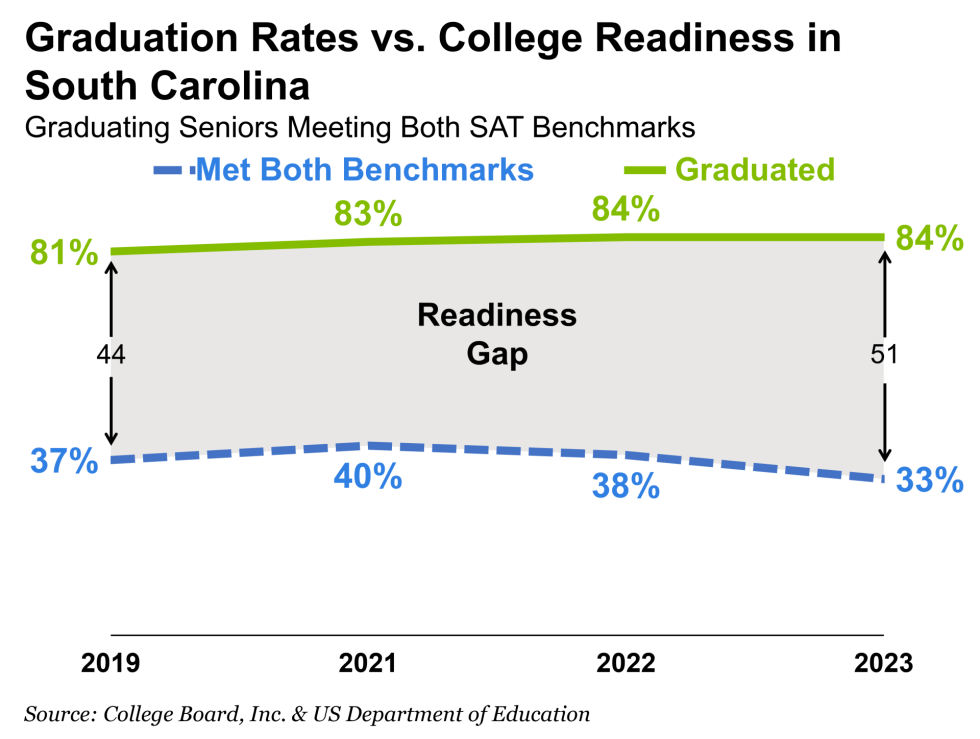
SREB states have significantly increased their high school graduation rates since 2002, but ACT and SAT college-readiness results show that too many graduates are leaving high school unprepared for college coursework. This readiness gap comes at a time when labor projections suggest that nearly two-thirds of future job openings will require candidates with postsecondary credentials.
ACT and SAT Performance by Student Group
Nationwide, of the students in the class of 2025 who took a college-readiness assessment, 30% met three or four ACT benchmarks and 39% met both SAT benchmarks. In SREB states, 26% met three or four ACT benchmarks and 56% met both SAT benchmarks.
A closer look at ACT and SAT benchmark results shows wider performance gaps in meeting the benchmarks for Black and Hispanic students than for Asian or white students.
Across the SREB region in 2025, ACT benchmarks results showed: 54% of Asian and 37% of white students met three or four college-readiness benchmarks; 18% of Hispanic students and 8% of Black students did.
The pattern of results was similar on the SAT. In 2025, 75% of Asian and 47% of white students met both SAT benchmarks, but only 22% of Hispanic students and 17% of Black students did nationwide. In the region, fewer than 26% of Black students and 39% of Hispanic students met both SAT benchmarks, compared with 63% of white students and 79% of Asian students.
STEM and Career and Technical Education
According to ACT results, students are particularly underprepared in STEM — science, technology, engineering and mathematics. Nationwide, 15% of students in the class of 2025 who took the ACT met the STEM benchmark, compared with 12% in the SREB region. While 37% of Asian students and 17% of white students in the SREB region met this benchmark, just 2\3% of Black and 6% of Hispanic students did.
In the seven SREB states with full ACT participation for the class of 2025, 1-3% of Black students and 3-6% of Hispanic students met the STEM benchmark; 8-20% of white students and 22-47% of Asian students did.
According to SREB’s 2017 publication, Valuing Both C’s in College- and Career-Readiness Accountability Systems, industry leaders already struggle to find workers who possess a broad mix of workplace skills, including STEM and industry-specific technical skills. Employers have expressed a need for workers who also have essential employability skills like the ability to communicate well, read technical manuals, work in teams and solve complex problems.
To prepare more students to graduate with the skills needed to meet workforce needs, states offer career and technical education courses, often as part of defined pathways or programs of study. Career pathways that connect to college ready courses and career opportunities teach critical technical and employability skills, but they also keep students engaged and achieving at higher levels, preventing dropouts and promoting transitions beyond high school.
CTE courses can be funded using federal Perkins V awards that require each state to report data on at least one of three program quality indicators. Most SREB states report how many students attained a recognized postsecondary credential — an industry-recognized certification, apprenticeship or degree. The other two available indicators are students who attained postsecondary credits and those who participated in work-based learning.