Further Insights into Gen Z Teacher Experiences
Longitudinal Study
 As baby boomers retire and occupational mobility increases in our society, education leaders increasingly look to younger professionals to fill the growing number of teaching vacancies. Yet the newer generation is vastly different in many ways to previous generations.
The Southern Regional Education Board interviewed Gen Z teachers and teacher candidates again, for further insight into Gen Z and their experiences and thoughts on the teaching profession today.
This online report features four additional findings to our first report, and a deeper look into three individual case studies for a longitudinal examination of Gen Z in teaching.
*All quotes are attributed to interviewees by chosen psuedonym.
Introduction: A Longitudinal Look at Generation Z Teachers
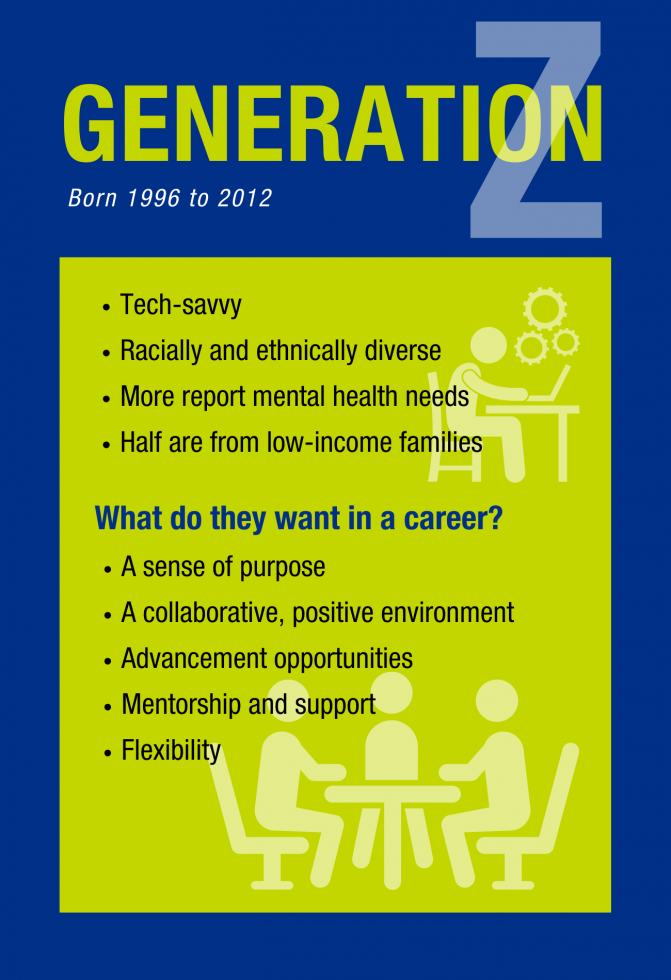
Generation Z, born between 1996 and 2012, has been entering the workforce for nearly a decade. Almost 70% of the generation is aged 18 or older, with the remaining following in four short years. Careers of service and purpose are of interest to this generation, and yet education has declined in popularity, not risen.
 To better understand why, SREB and researchers at Vanderbilt University conducted a mixed-methods study of this generation and their interest, or lack thereof, in teaching in 2023. Three years later, SREB researchers revisited this question with a longitudinal qualitative study on the current professional experiences of Gen Z and their views of the career today. Our goal for this study is to continue finding answers for how to better attract and retain Gen Z in the teaching profession.
In this study, SREB interviewed nearly 30 Gen Z early-career teachers and teacher candidates from nine SREB states — Alabama, Arkansas, Georgia, Kentucky, Maryland, North Carolina, Oklahoma, Tennessee and Virginia.
Three case studies and four findings are outlined below.
A Brief Overview of 2023 Findings on Gen Z in Teaching
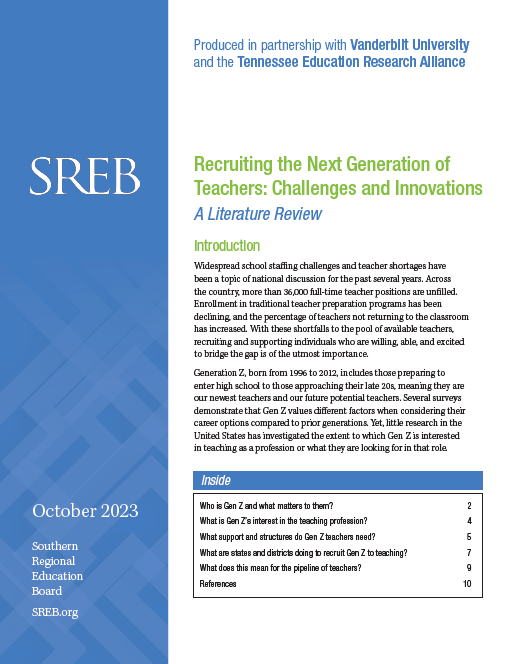
SREB and Vanderbilt University partnered to study the declining interest in teaching among Gen Z despite rising vacancies in the profession in 2023. A preceding review of the literature profiled the generation. The mixed-methods study, using data from Tennessee and Kentucky, as well as qualitative interviews from the same states, found that:
- Interest is concentrated among white female students with lower ACT scores.
- Alternative pathways and early exposure are increasing.
- Gen Z values purpose but perceives teaching as lacking support, pay, and flexibility, signaling a need for stronger compensation, mentorship and working conditions.
See our previous study findings from 2023.
What is Known About Gen Z and Why Focus on this Cohort?
 Generation Z is the primary pipeline to fill teacher shortages and vacancies left by retirees and leavers. This generation is entering the workforce during a high-stress, rapidly changing era marked by economic and workforce instability, rapid technological change, a rise in high-needs populations, and social unrest. This reality moves them to seek both joy and stability.
As noted in the previous study, Gen Z values purpose-driven work, yet education competes with a range of other service-oriented career professions. Their motivation for meaningful work is strong but fragile. Those interested in education careers cite a passion for helping children and their community. However, financial stability, work-life balance and overall quality of life are priority factors they will not ignore as they weigh career decisions.
Gen Z’s professional interests do not align with current education systems. Early career teachers report feeling underprepared and under-supported. Among those interviewed this year, teaching is widely described as an uphill battle, chaotic, overwhelming and unorganized, with expectations to take on multiple roles and heavy workloads. They feel constrained by limited earning potential and undervalued as professionals.
Gen Z represents both the greatest opportunity and the greatest risk for America’s future educator workforce: a shrinking, evolving, values-driven cohort entering a profession that is not currently designed to meet their expectations.
Case Studies: Three Gen Z Teachers Over Three Years’ Time
SREB interviewed three early career generation Z teachers in 2023 and talked to them again in 2026. From these teachers’ perspectives, we build on their insight, peering into the reality of young, professional educator experiences in the 2020s.
➝ Kerrie, High School Mathematics Teacher, Tennessee
Kerrie is a Gen Z high school geometry teacher in Tennessee, now in her fifth year of teaching. Since 2023, she has taken on additional leadership roles as mathematics department chair and mentor teacher. Early in her career, Kerrie was motivated by math content; however, that motivation has since shifted toward student relationships and community impact.
Kerrie’s Challenges
- Broader concerns about humanity currently present larger challenges for Kerrie than academic ones. She feels a heightened responsibility to protect her students, the majority of whom are multilingual learners.
- Structural gaps in teacher support continue to create confusion rather than coherence for Kerrie and her colleagues. While coaching and administrative roles exist, there is no clear guidance on how each role should support newer teachers.
Kerrie’s Policy-Relevant Insights
- Work-life balance is the most important factor for remaining in the profession for Kerrie. She used to perceive it as laziness when she did not complete everything at the end of the day, but now she prioritizes her relationships and hobbies over doing work at home.
- Flexible scheduling, such as a four-day school week with an extended calendar, is a small fix Kerrie believes can improve teacher sustainability.
- AI’s role in education will change how teachers work, but Kerrie asserts it is unlikely to reduce workload, especially since technology has been around and teachers are still working long hours.
- Administrative quality, specifically experiencing unprofessional administrators, would push Kerrie to leave her current school.
- New staff support guidance would help Kerrie and her colleagues understand how they can better support new teacher development.
Outlook: Kerrie remains committed to teaching but acknowledges uncertainty about her long-term path given personal and professional variables. She believes teachers stay in the profession when they feel a genuine calling and leave when difficult conditions erode this passion. As a Generation Z teacher, she views her peers as a force for positive change that prioritizes both student and teacher well-being while challenging outdated professional norms. She urges policymakers and fellow educators to actively counter negative narratives about teaching, noting that teachers who affirm their commitment to the profession hold real power in shaping public perception.
➝ Callie, High School Visual Arts Teacher, North Carolina
Callie is a Gen Z visual arts teacher with six years of classroom experience. She spent her first three years teaching art at a Tennessee high school before relocating to a charter school in North Carolina. Over time, Callie’s instructional skills have strengthened considerably, particularly in curriculum delivery, classroom management and differentiated instruction. She credits supportive administration, access to professional development and a collaborative planning period with colleagues as key drivers of her growth.
Callie’s Challenges
- Curricular control in Tennessee made it increasingly difficult to teach freely and professionally, ultimately pushing her to leave the state.
- Teacher compensation remains a serious concern for Callie. She calculated that without a spouse’s income, she could not afford rent within 20 miles of her school — a reality she describes as unsustainable and demoralizing.
- Special education coordination was a persistent challenge in her prior context, where understaffing left case managers unable to adequately support classroom teachers in understanding student needs.
- Communication gaps at her current school, though improving, have created occasional issues — such as not being informed when a student transferred, which reflected poorly on the school.
Callie’s Policy-Relevant Insights
- Teacher autonomy and professional respect contribute to Callie’s decision to remain in the profession. She would also leave teaching if stripped of her ability to meaningfully serve her students.
- Teacher compensation and overall better financial support is one way Callie views the profession could attract more talent. Callie said she is thankful she is married because as a teacher with almost six years of experience she is unable to independently afford housing near her school and supplements her income by selling pottery.
- Teacher well-being initiatives such as substitute coverage for grading days and staff retreats are supports for Callie.
- AI is a meaningful support tool for Callie and programs like Magic School lighten the workload and reduce the burden of sensitive communications.
- Professional development opportunities funded by Callie’s school have meaningfully strengthened her instructional skills and expertise.
Outlook: Callie’s retention outlook has improved significantly since 2023, when she anticipated leaving within five years. She now plans to remain in teaching for seven to 10 years, most likely at her current school. Her stability is directly tied to strong leadership, collegial support and professional autonomy, but says she would leave if those conditions deteriorated. She emphasizes that surrounding oneself with genuinely passionate colleagues is essential to sustaining a long, fulfilling career.
➝ Samantha, High School Health Teacher and Multilingual Learner Specialist, Kentucky
Samantha has degrees in special education, elementary education and a master’s in multilingual learner instruction. She recently transitioned from a K-8 English learner support role in a small district to teaching health at a specialized high school serving multilingual learners. Health is outside of her expertise, but she plans to transition into a role that aligns to her passion and skillset next year. Her new district offers more competitive pay, stronger benefits and significantly more institutional support. Samantha has always been drawn to teaching, finding her calling of working with multilingual learners. She credits observing and planning alongside experienced colleagues to her growth as a teacher.
Samantha’s Key Challenges
- Role misalignment in her previous position eroded the quality of specialized services. A co-teaching model designed to support multilingual learners shifted in practice to general classroom support, leaving her caseload of students underserved and her expertise underutilized.
- Understaffed schools and undertrained colleagues in her former district, many of whom were still completing teacher preparation programs while serving as teachers of record, created an unsustainable workload for Samantha and compromised school-wide instructional quality.
- Student stress is creating measurable impacts in Samantha’s classroom. Her students, many new to American schools, are experiencing significant fear and isolation and the resulting stress impacts Samantha’s well-being as well.
- Burnout is a real and present risk for Samantha and her colleagues. She believes she cannot exit the profession because she is called to be a teacher. However, she cites the lack of adequate compensation, mentorship programs and structured professional development as major stressors.
Samantha’s Policy-Relevant Insights
- Teacher compensation was the main reason Samantha exited her previous district. The emotional and physical energy she exerted as a teacher while struggling to meet basic financial needs was unsustainable and inequitable.
- Instructional models should be clearly defined and protected. As a specialist, who transitioned to a co-teaching model, Samantha was expected to serve all students in the class, while her specific caseload of MLL students were underserved.
- Non-traditionally prepared teachers in Samantha’s former teaching context received little district guidance and support to successfully do their jobs which increased the burden on Samantha and other colleagues.
- AI is a meaningful support tool that Samantha credits making her current transition into teaching health workable. She uses it to unpack standards and develop her scope and sequence, something she would not have had time to develop otherwise.
Outlook: Despite ongoing challenges, Samantha is committed to remaining in public education serving low-income communities, provided she has access to adequate compensation, institutional support and role alignment with her expertise. Having witnessed unsustainable work patterns in older colleagues, she views firm work-life boundaries as a professional necessity and key to long-term retention. She notes a declining interest in teaching among Gen Z and emphasizes that structured mentorship, meaningful professional development and formal teacher preparation are foundational.
FINDING 1: Gen Z teachers are strongly motivated to teach by intrinsic factors but reliance on this alone will not sustain the pipeline.
Many new teachers feel the profession is more than just a job; it’s a meaningful role that deeply impacts students’ lives and can be personally rewarding despite its challenges. It is a profession of passion.
Several themes arose from the Gen Z teachers and teacher candidates, including the reasons they were attracted to the profession:
- A lifelong interest in working with children
- High motivation to help others learn and grow
- Desire to make a positive impact on students’ lives and futures
- Inspiration from their own positive personal experiences with teachers
These themes reaffirm findings from our previous research, showing that a majority of new educators, both in Gen Z and earlier generations, are inspired to teach from an early age, even if they do not follow a direct path to the profession. This underscores the importance of policies and programs that capitalize early interest, as positive perceptions of the profession can be key to attracting more Gen Zer’s to education.
Many Gen Z teachers emphasized that better compensation, increased respect for the teaching profession, and cultures of support from administration and parents are necessary to attract teaching talent in greater numbers.
“I think I was in 8th grade the first time that I really considered being a teacher. It was one of those things where I was helping a friend with some math assignment … and it was just so fun to help my friend go from not understand it to understanding it.” – Jeremy, Gen Z teacher candidate in AL
“I have always wanted to be a teacher my whole entire life, which I feel like I hear from a lot of my friends as well. We’ve just kind of always known that we wanted to be a teacher, but for me … I’ve always loved kids.” – Charlotte, Gen Z teacher candidate in NC
FINDING 2: Gen Z uses AI selectively and has significant concerns regarding its use for instruction.
“I don’t use it at all. I hate it … I have strong opinions about AI really taking away the ability for independent thought.” – Kerrie, Gen Z teacher in TN
Attitudes towards artificial intelligence as a resource were mixed. Some Gen Z teachers use AI to support lesson planning, brainstorming engaging activities and for administrative tasks such as drafting emails and reports. However, some teachers refuse to use it in their work unless specifically directed to by their supervisors. Their reservations are grounded in concerns about confidentiality, copyright and ethical implications such as environmental impact.
Many teachers also worry that students are becoming overly reliant on AI. A common sentiment amongst interviewees was that students must learn how to use AI properly, as a starting point or a peer reviewing tool, but not as a replacement for all effort or expertise.
“But that is something I want my students to understand, that you can use AI … just use it as a cushion, not as the whole cake.” – Sunnie, Gen Z teacher in AL
FINDING 3: Many Gen Z educators experience significant workload, limited autonomy, and financially untenable compensation that drive intentions to leave the classroom.
Interviews repeatedly revealed a recurring theme of the demanding nature of teaching and the emotional and physical toll of the job with extensive planning, grading and classroom management struggles on top of differentiating student instructional and emotional needs. Nearly a third of the interviewees plan to move into another role in K-12 education outside of teaching, and one interviewee reported they will seek another role in education, but outside of K-12 schools.
Several structural elements of the job were cited as factors that make the professional more or less desirable to those with a passion for educating young people. Among the most common were sustainable pay, reasonable autonomy and the workplace environment the school leaders fostered. When asked about workforce challenges, most interviewees brought up pay. Several mentioned that if or when financial stability became an issue for them individually or their current or future families, they would be motivated to leave the profession.
“Pay is still the largest issue, I think. I don’t think that the overworking part is going to be as much of a problem in this new role (for me) but just being underappreciated … it really is a thankless job. You get overlooked a lot. People don’t recognize how hard you’re working because everybody’s working that hard.” – Samantha, Gen Z teacher in KY
Some Gen Z teachers report having input in decision-making processes at their school, including control over their lesson plans and curriculum. Others say they have minimal input into decisions that affect their teaching and experience a culture of compliance over competence. As a result, many teachers feel like they must constantly prove their competence and expertise as trained professionals.
Environments viewed as toxic, such as schools in which staff are discouraged from asking questions, where teachers are expected to work in isolation or where accountability systems are punitive only rather than growth-based, led some interviewees to already leave a position in teaching for another school. Others commented that these types of environments would motivate them to seek employment elsewhere.
“Things like that, that just made it really difficult to teach, and it felt like I wasn’t being taken seriously as a professional. So it kind of goes back to that respect thing. If I don’t feel like I’m respected as a professional, I want out. You can get someone else to do it because … it’s just insane.” – Callie, Gen Z teacher in NC
Finding 4: Supportive school environments are critical to retaining Gen Z teachers.
Nearly two-thirds of the interviewed current teachers expressed a strong desire to remain in the classroom, often long term, citing love for teaching, students and supportive colleagues. The teachers who reported intentions to remain in the classroom for at least the next five years were the same who reported a supportive staff culture and strong, positive leadership, highlighting the critical importance of good working conditions to retain staff.
Interviewees who feel supported by their school administration, colleagues, departmental teams and mentors reference a collaborative and emotionally supportive environment as a key support to begin their careers in the classroom. Additional helpful support included high-quality mentorship programs, both formal and informal, as well as informal well-being support like frequent check-ins from empathetic administrators.
“I would say if the leadership gets terrible and just that support isn’t there, that is one thing that does (affect retention). I’m hard on having leadership that supports you … it’s true leadership, so that would be one thing that would because students’ behavior and all that, it doesn’t drive me away. It’s really the leadership.” – Dana, Gen Z teacher in GA
Unfortunately, not all Gen Z teachers report experiencing positive support. Several interviewees expressed a lack of administrator and colleague support, citing issues with inconsistent enforcement of policies like cell phone confiscation or implementation of various programs, poor communication and a perceived lack of care for teacher well-being. Many new teachers expressed frustration at large, unmanageable classes with persistent behavioral challenges. They cite difficulty engaging students and limited parental involvement, making it more difficult to partner with families to support student achievement. Limited involvement, however, was cited as only part of the problem, with parental disrespect towards young teachers and the profession further discouraging the generation.
Overall, unsupportive and even toxic work environments and the inability to afford a basic quality of life on a teacher’s pay were the top reasons Gen Z teachers said will or may push them to leave education, whereas comprehensive support and positive community and culture seemed to foster planned persistence and retention.
“Me and my department, we want so badly (for) the district to address curriculum. There have been so many attempts to address curriculum, and every single time it has been somebody’s friend with a bunch of money in a program comes in, and they pay into that. And so as is the story for education, we constantly change things over and over again without any consistency, and then the follow-through keeps getting weak. So then we have bad results, and they go, oh, let’s change again. One of the things that I really, really would love as support is this idea of a consistent curriculum we can work towards to also establish more vertical consistency, as well as horizontal … I’m getting so many kids from middle school that come from so many different schools, where every single teacher is so different.” – Riley, Gen Z teacher in VA
What We Learned From These Findings
Insights and Policy Implications
 The experiences of early-career teachers and 2026 Gen Z interviewees point to a consistent conclusion: teaching remains deeply meaningful, but purpose alone cannot sustain a high-quality educator workforce. Teachers are most likely to thrive in environments characterized by supportive leadership, professional autonomy, collaboration and strong student relationships. Compensation stands out as the most urgent structural barrier. Many Gen Z teachers — despite strong preparation and commitment — struggle to achieve financial stability, making long-term retention increasingly difficult. In the absence of these conditions, even highly committed educators question their future in the classroom.
Generation Z as Catalysts for Change
Generation Z is actively reshaping expectations for the profession. Their decisions to change schools, relocate or leave teaching altogether reflect clear responses to working conditions and policy environments. Their emphasis on work-life balance, professional respect and accountability signals not a lack of commitment, but a demand for a more sustainable and modernized profession — particularly as teachers retire and workforce gaps widen.
Teaching is Both a Calling and a Profession
Gen Z teachers often describe entering the profession through personal inspiration — family influence, impactful educator, or a desire to support young people. This sense of calling is a powerful asset, but it cannot compensate indefinitely for inadequate pay, limited respect or weak support. Sustaining this pipeline requires intentional early recruitment and strong preparation through quality routes. Equally important is reframing the profession as intellectually rigorous, impactful, and worthy of long-term investment.
What Generation Z Contributes
Generation Z brings distinct strengths, particularly in technological fluency, adaptability and student connection. As schools navigate the integration of AI, many Gen Z teachers are leading its practical and ethical application, using it to enhance, rather than replace, professional judgment. Recognizing these educators as contributors — not just novices — creates opportunities for cross-generational learning. Structured opportunities for Gen Z teachers to share expertise can strengthen instructional practice across the profession.
A Path Forward: What It Will Take to Retain Generation Z Teachers
Retaining Gen Z educators requires aligning policies and practices with the realities of the profession today. The findings point to a focused set of actionable priorities:
- Provide structured, sustained early-career support
Invest in high-quality mentorship, collaborative environments and protected time for development. Support systems must be intentional, consistent and well-resourced, not informal or ad hoc. - Ensure competitive, stable compensation
Teachers must be able to achieve financial stability. Without this foundation, long-term retention is unlikely, regardless of commitment or preparation. - Strengthen the quality of school leadership
Effective leaders foster trust, reduce unnecessary burdens and create supportive working conditions. Poor leadership and micromanagement remain key drivers of attrition. - Treat teachers as professionals
Preserve instructional autonomy, recognize contributions and ensure teachers are respected by administrators, families and the public. Respect must be embedded in daily practice, not just rhetoric. - Elevate teacher voice in decision-making
Create meaningful, ongoing opportunities for Gen Z teachers to inform policies and practices. Inclusion strengthens both retention and the effectiveness of decisions.
These are not extraordinary demands — they are the baseline conditions required for most teachers to stay, succeed and sustain the profession over time.
About This Report
This study was conducted using qualitative case study methodology. SREB staff interviewed 27 Gen Z teacher candidates and newly hired teachers across six colleges and universities and 18 school districts in nine states: Alabama, Arkansas, Georgia, Kentucky, Maryland, North Carolina, Oklahoma, Tennessee and Virginia.
The interviews focused on learning what influences Gen Z ’s desire to teach, what affects their practices and experiences in schools and classrooms, and what influences their decisions to remain in or leave the profession.
Interviewees were studying or teaching across a range of demographics, grade levels and subject areas, including English, mathematics, social studies, the sciences, fine arts, English as a second language, world languages, physical education, career and technical education. Thirty percent of the participants were current teacher candidates enrolled in preparation programs, with 70% employed as early-career educators in public schools. Most (70%) of the participants followed a traditional pathway of a bachelor’s or master’s degree to obtain their teaching certification and license, while the remaining pursued alternative certification programs or pursued additional degrees to become certified teachers.
Suggested Citation
Pierce, S., Nadzam, J., Boren, M. (2026). Further Insights into Gen Z Teacher Experiences. Southern Regional Education Board. https://www.sreb.org/publication/gen-Z-teacher-experiences
This report is licensed under CC BY 4.0.